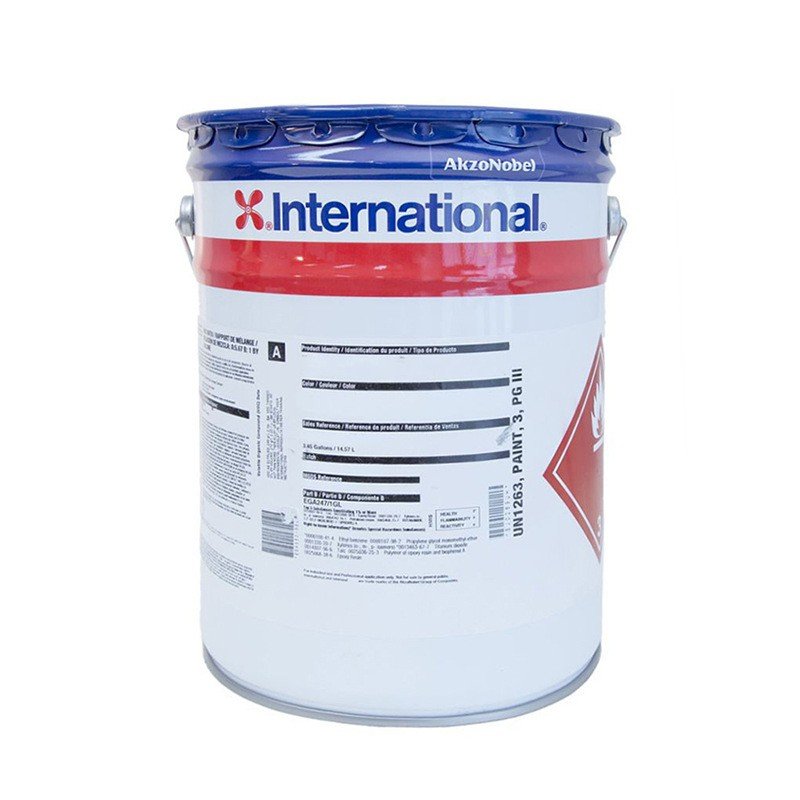
Interline 344 Inorganic Zinc Tank Coating belongs to Inorganic Zinc Silicate. A tank coating suitable for carrying petroleum products, solvents (including methanol) and other neutral cargoes. A two-component zinc silicate tank coating complying with volatile organic compound content (320 g/L) regulations. Parameters on this page: Volume Solids 81% ± 2% (ASTM D2697-86), Dry Film Thickness 100 µm, Theoretical Spreading Rate 8.1 m²/L. Comparable models from the same brand: Interline 605 Inorganic Zinc Silicate, Intercept 7000 Linear Polishing Antifouling, Intercept 8500 LPP Tin-free Linear Polishing Polymer Antifouling.
Parameter source: International INTERNATIONAL original technical data sheet (TDS) “Interline 344 Inorganic Zinc Tank Coating”; values such as spreading rate are converted from TDS parameters, for selection reference only.
The above content is compiled from the manufacturer's datasheet and this site's parameter tables. For selection, coating systems and lead times, pleaseContact Usfor confirmation.
This page carries the full TDS for this product, translated from the manufacturer's original document. No file download is needed; for an original-language copy, send an enquiry.
| Volume Solids | 81% ± 2% (ASTM D2697-86) |
|---|---|
| Dry Film Thickness | 100 µm |
| Theoretical Spreading Rate | 8.1 m²/L |
| VOC | 320 g/L (as supplied) (EPA Method 24) 84 g/kg (as… |
| Density / Specific Gravity | — |
| Number of Components | Two-component |
| Mixing Ratio | Component A : Component B = 1.0 : 2.86 (by weight) |
| Colour / Appearance | QHA345 red-grey |
| Gloss | Matt |
For more Q&A on selection, application, acceptance and defect diagnosis, seeFAQsection.
A two-component zinc silicate tank coating complying with volatile organic compound content (320 g/L) regulations.
A tank coating suitable for carrying petroleum products, solvents (including methanol) and other neutral cargoes.
For newbuilding or maintenance and repair.
| Colour | QHA345 red-grey |
|---|---|
| Topcoat/gloss | Matt |
| Component B (curing agent) | QHA346 (Zinc Dust) |
| Volume Solids | 81% ±2% (ASTM D2697-86) |
| Mixing ratio | Component A : Component B = 1.0 : 2.86 (by weight) |
| Standard film thickness | 100 µm dry film thickness (123 µm wet film thickness) |
| Theoretical Spreading Rate | Theoretical spreading rate at 100 µm dry film thickness is 8.1 m²/L, allowing appropriate loss factor*. Spreading rate is calculated from data determined by the volume solids test (ISO 3233:1988). Observation of usage rate shall be carried out to obtain the ideal measured value of actual spreading rate. |
| Application Methods | Airless spray, brush, conventional spray, roller |
| Flash Point | Component A 19°C; Component B non-combustible; after mixing 21°C (Setaflash) (ASTM D-3278) |
| Induction Time | Not required |
| Drying data | 5°C | 10°C | 25°C | 40°C |
| Touch dry [ISO 9117/3:2010] | 40 min | 30 min | 15 min | |
| Hard dry [ISO 9117-1:2009] | 3 h | 2 h | 60 min | |
| Pot life after mixing | 16 h | 12 h | 8 h | 4 h |
| Recoat data — see the “Limitations” section | Substrate Temperature | |||||||
| 5°C | 10°C | 25°C | 40°C | |||||
| When recoating the following products | Minimum | Maximum | Minimum | Maximum | Minimum | Maximum | Minimum | Maximum |
| Interline 344 | 24 h | 10 days | 24 h | 10 days | 24 h | 10 days | 24 h | 7 days |
| Volatile Organic Compounds | 320 g/L (as supplied) (EPA Method 24) 84 g/kg (as supplied liquid paint). EU Solvent Emissions Directive (Council Directive 1999/13/EC) VOC values are typical values and are provided for reference only. They may vary with factors such as colour and normal manufacturing tolerances. |
|---|
For the paint system best suited to the surface to be protected, consult your local International Paint representative.
For cargo oil tank use, refer to Interline 344 cargo oil tank application procedure.
Applied in accordance with the standard Worldwide Marine Specifications.
All surfaces to be coated must be clean, dry and free of contaminants.
Wash with high-pressure or ordinary fresh water as appropriate, and remove all oil, grease, soluble contaminants and other foreign matter in accordance with the SSPC-SP1 solvent cleaning standard.
On newbuildings, remove weld spatter and grind welds and sharp edges smooth where required.
The product shall be applied only to surfaces abrasive-blast-cleaned to Sa2.5 (ISO 8501-1:2007).
A sharp, angular surface profile of 30–65 µm is recommended.
Major repair: abrasive blast clean to Sa 2.5 (ISO 8501-1:2007).
Interline 344 must be applied before oxidation of the steel occurs. If oxidation has occurred, the entire oxidized area shall be re-blasted to the standard specified above.
Surface defects exposed during blasting must be ground, welded or treated by a suitable method.
For maintenance, consult International Paint.
For specific advice, consult your local International Paint representative.
Note: for the marine environment in North America, the following surface preparation standard may be used: SSPC-SP10 in place of Sa 2.5 (ISO 8501-1:2007)
Interline 344 is supplied as two components, a liquid binder component (Component A) and a zinc powder component (Component B). The full kit shall always be mixed in the ratio as supplied. (1) Stir Component A with a mechanical stirrer. (2) Remove and discard the desiccant bag from the zinc powder (Component B). (3) While stirring with a mechanical stirrer, slowly add the zinc powder to Component A (liquid) and stir for at least 5 min. Do not add the liquid to the powder. (4) Strain the paint through a 30–60 mesh screen into a container or pressure pot fitted with a mechanical stirrer. (5) During spraying, run the mechanical stirrer at low speed (approximately 20 rpm) to keep the zinc powder in suspension. (6) Keep the system sealed and free of moisture. The application time after mixing varies with temperature and humidity conditions; if excessive moisture is present during mixing or in the equipment, the application time after mixing will be shortened. In extreme cases, this may cause the paint to gel.
No thinning is required for airless spray application. For conventional spray application, use GTA138 (maximum 5% by volume).
Do not thin beyond the range permitted by local environmental regulations.
Recommended nozzle tip size 0.38–0.53 mm (15–21 thou). Total fluid output pressure at the nozzle not less than 112–141 kg/cm² (1590–2010 psi). Use a 60 mesh filter in the pump manifold or install a filter in the line.
Use suitable dedicated equipment. Thinning may be required.
Brush application is recommended for small areas only. Several coats may be required to achieve the specified film thickness.
Roller application is recommended for small areas only. Several coats may be required to achieve the specified film thickness.
Do not leave paint in hoses, spray guns or spray equipment. Flush all equipment thoroughly with International thinner. Once mixed, paint should not be resealed; if work is interrupted for too long, mix a fresh batch before resuming application.
All equipment should be cleaned immediately after use with International thinner. Flushing spray equipment periodically during the day is good working practice. Cleaning frequency depends on the volume sprayed, temperature and time in use (including delays). Do not exceed the pot life of the paint.
All surplus paint and empty containers must be disposed of in accordance with appropriate local regulations/laws.
If welding or flame cutting is performed on metal coated with this product, dust and fumes will be released; use suitable personal protective equipment and local exhaust ventilation. In North America, follow the instructions in ANSI/ASC Z49.1 “Safety in Welding and Cutting”.
All work related to the application and use of this product must comply with national health, safety and environmental protection standards and regulations.
Before using this product, obtain, read and follow the health and safety information in the Material Safety Data Sheet for the product. Read and observe all precautions in the Material Safety Data Sheet and on the container label. If these warnings and requirements are not fully understood, or cannot be strictly observed, do not use the product. During application and drying of the product, provide adequate ventilation and protective measures to keep solvent vapour concentrations within safe limits, so as to prevent poisoning or oxygen deficiency. Take protective measures to avoid skin and eye contact with the product (e.g. gloves, goggles, face shield, barrier cream). Specific safety measures depend on the application method and working environment.
Emergency contact: USA/Canada — medical 1-800-854-6813; Europe — tel. (44) 191 4696111, hospital and doctor (44) 207 6359191; China — tel. (86) 532 83889090; other regions — contact the regional office.
Consult International (International Paint) to determine whether Interline 344 is suitable for the cargo to be carried.
Drying times and overcoating intervals may vary with site factors such as humidity, tank geometry and ventilation rate.
For the required interval between completion of coating and cargo loading, refer to the detailed coating application procedure.
Care shall be taken to maintain the recommended wet film thickness to avoid excessive dry film thickness.
Excessive thickness of Interline 344 may cause cracking; if cracking occurs, the entire affected area shall be thoroughly removed by abrasive blasting and re-applied in accordance with the original scheme.
Recoat data are for guidance only and depend on local climatic and environmental conditions. For specific advice, consult your local International Paint representative.
Apply in good weather. The temperature of the surface to be coated must be at least 3 °C above the dew point. Unless otherwise specifically instructed, raise the paint temperature to between 21 and 27 °C before mixing and application to achieve optimum application performance. Unmixed paint (in sealed containers) must be stored protectively as specified in the Storage section of this product data sheet. The technical and application data given here are intended as general guidance for establishing an application procedure. Test results are obtained in a controlled laboratory environment, and International Paint does not claim that the published test results, or any other test results, accurately represent results obtained in all site environments. Because application, environmental and design parameters vary widely, care must be exercised in coating selection, performance verification and use.
| Packaging Specifications | Component A | Component B | ||
| Volume | Packaging | Volume | Packaging | |
| 5 US gal | 2.42 US gal | 5 US gal | 1.22 US gal | 5 US gal |
| 10 L | 9.16 L | 10 L | 4.62 L | 20 L |
For other packaging sizes, consult International Paint.
| Packaging Specifications | Packaging weight |
|---|---|
| 5 US gal | 97.8 lb |
| 10 L | 12.01 kg |
| 20 L | 34.55 kg |
| Shelf life | Component A — when stored in a protected environment at 25 °C or below, minimum 9 months from date of manufacture. |
|---|
Component B — when stored in a protected environment at 25 °C or below, minimum 12 months.
Thereafter, re-inspection is required. Store in a cool, dry place away from heat and sources of ignition.
Information is subject to the manufacturer's latest version; the manufacturer's latest TDS prevails.
The technical parameters on this page are taken from the product's original manufacturer technical datasheet, the copyright of which belongs to the manufacturer. If a rights holder considers the presentation inappropriate, contact us for verification and handling.
Packaging specifications and batch lead times are subject to actual availability. PleaseContact Uscontact us for project-based calculation.