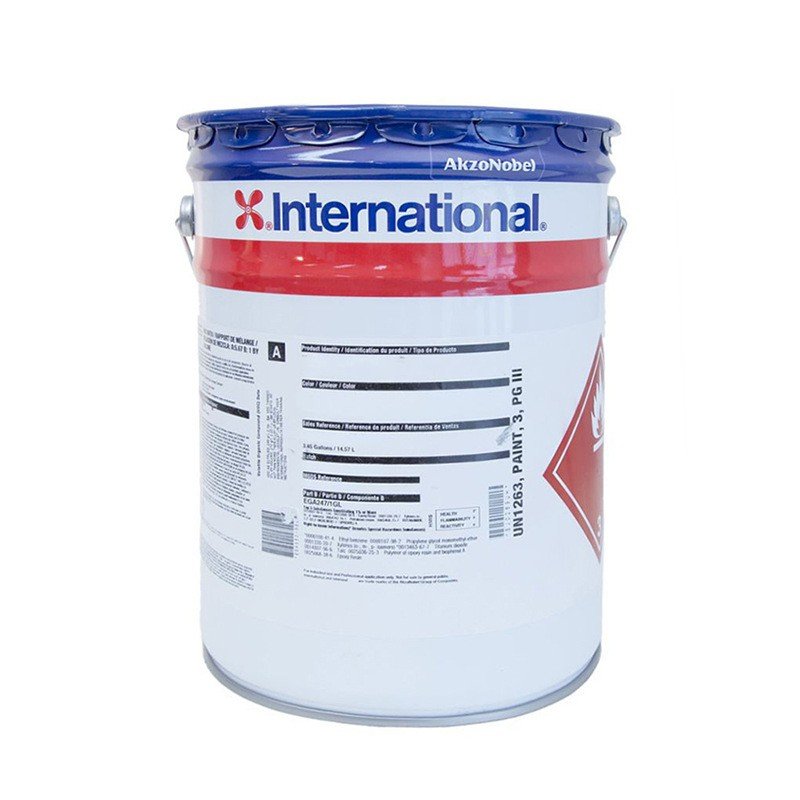
Interzone 1000 Glass Flake Epoxy is a glass flake coating, in the epoxy coating system. It provides protection for steel structures in environments requiring high abrasion and corrosion resistance, including: splash zones of offshore structures, breakwaters, decks, bridges, chemical plants, paper mills and water treatment plants. An extremely high-solids, low-VOC two-component high-build epoxy coating containing a large amount of chemical-resistant glass flakes, providing outstanding corrosion resistance, abrasion resistance and chemical resistance. The substrate temperature must be at least 3 °C (5 °F) above the dew point. Parameters on this page: dry film thickness 500-1000 µm (20-40 mil), theoretical spreading rate 1.80 m²/L, number of components: two-component.
Parameter source: AKZONOBEL original technical data sheet (TDS) for Interzone 1000 Glass Flake Epoxy; spreading rate and other values are converted from TDS parameters and provided for product selection reference only.
The above content is compiled from the manufacturer's datasheet and this site's parameter tables. For selection, coating systems and lead times, pleaseContact Usfor confirmation.
This page carries the full TDS for this product, translated from the manufacturer's original document. No file download is needed; for an original-language copy, send an enquiry.
| Volume Solids | 92% |
|---|---|
| Dry Film Thickness | 500–1000 µm (20–40 mil) |
| Theoretical Spreading Rate | 1.80 m²/L |
| VOC | 0.62 lb/gal (75 g/L) US EPA Method 24 70 … |
| Density / Specific Gravity | 1.3 kg/L (10.8 lb/gal) |
| Number of Components | Two-component |
| Thinner | Do not exceed the thinning limits of local environmental regulations |
| Mixing Ratio | 3.5 parts : 1.0 part (by volume) |
| Colour / Appearance | Available in a limited range of colours, INTERZONE 1000 |
For more Q&A on selection, application, acceptance and defect diagnosis, seeFAQsection.
An extremely high-solids, low-VOC two-component high-build epoxy coating containing a large amount of chemical-resistant glass flakes, providing outstanding corrosion resistance, abrasion resistance and chemical resistance.
It provides protection for steel structures in environments requiring high abrasion and corrosion resistance, including: splash zones of offshore structures, breakwaters, decks, bridges, chemical plants, paper mills and water treatment plants.
It has outstanding cathodic disbondment resistance and good compatibility with sacrificial anode and impressed current systems; these properties make Interzone 1000 especially suitable for long-term protection of subsea structures.
Use with a suitable aggregate as part of a non-skid deck coating system.
| Colour | Available in a limited range of colours, INTERZONE 1000 |
|---|---|
| Gloss | Not applicable |
| Volume Solids | 92% |
| Typical thickness | Dry film thickness 500-1000 µm (20-40 mil), equivalent to wet film thickness 543-1087 µm (21.7-43.5 mil) |
| Theoretical Spreading Rate | At 500 µm dry film thickness and the stated volume solids: 1.80 m²/L; at 20 mil dry film thickness and the stated volume solids: 74 ft²/US gal |
| Practical Spreading Rate | Allowing for a suitable loss factor |
| Application Methods | Airless spray, air spray, brush. Drying time; recommended topcoat recoat interval |
| Temperature | Surface Dry | Hard Dry | Minimum | Maximum |
| 10°C (50°F) | 14 h | 26 h | 7 days | |
| 15°C (59°F) | 8 h | 18 h | 5 days | |
| 25°C (77°F) | 5 h | 12 h | 4 days | |
| 40°C (104°F) | 2 h | 5 h | 1 day | |
| Flash point (typical) | Component A 44 °C (111 °F); Component B >101 °C (214 °F); mixed 56 °C (133 °F) |
|---|---|
| Product weight | 1.3 kg/L (10.8 lb/gal) |
| Volatile Organic Compounds | 0.62 lb/gal (75 g/L) US EPA Method 24; 70 g/kg EU Solvent Emissions Directive (EU Directive 2010/75/EU); coating hazard GB 30981.2-S-Pb≤1000-NC, in compliance with GB 30981.2-2025. For further details, see the "Product Characteristics" section. |
All surfaces to be coated must be clean, dry and free of contaminants. Before application, all surfaces must be assessed and prepared in accordance with ISO 8504:2019.
Oil and grease must be removed in accordance with the SSPC-SP1 solvent cleaning standard.
Blast cleaning: abrasive blast clean to Sa 2½ (ISO 8501-1:2007) or SSPC-SP10. If oxidation occurs between blast cleaning and application of Interzone 1000, the surface should be re-blasted to the specified visual standard.
Surface defects exposed during abrasive blasting must be ground, filled or treated by a suitable method.
Recommended angular surface roughness of 75–100 µm (3–4 mils).
Shop-primed steel: Interzone 1000 can be applied over an approved anticorrosive primer. The primer surface must be dry and free from any contaminants; Interzone 1000 must be applied within the specified recoating interval (see the relevant product data sheet).
Cracked or damaged areas should be prepared to the specified standard (e.g. abrasive blast cleaning to Sa 2½ (ISO 8501-1:2007) or SSPC-SP10, or power tool cleaning to SSPC-SP11), and the primer repaired before applying Interzone 1000.
Weld seams and damaged areas should be blast cleaned to Sa 2½ (ISO 8501-1:2007) or SSPC-SP10. If the shop primer shows extensive damage or widespread scattered damage, overall sweep blasting may be required.
| Mixing | This product is supplied in two containers forming one unit. Mix the two components in the specified ratio in one operation. Once mixed, use within the specified pot life. |
|---|
(1) Stir the base (Component A) with a power mixer.
(2) Mix all of the curing agent (Component B) with the base (Component A) and stir thoroughly with a power mixer.
Avoid prolonged stirring, as the heat generated greatly shortens the pot life.
| Mixing ratio | 3.5 parts : 1.0 part (by volume) |
|---|
| Pot life | 10°C (50°F) | 15°C (59°F) | 25°C (77°F) | 40°C (104°F) |
| 4 h | 3 h | 1 h | 30 min |
| Suitable for airless spray | Recommended nozzle diameter 0.92-1.09 mm (36-43 thousandths of an inch); total paint pressure at the nozzle not less than 211 kg/cm² (3000 lb/in²). |
|---|
| Air Spray | Recommended | Spray gun | DeVilbiss MBC or JGA |
| Air nozzle | 62 | ||
| (with pressure pot) | Nozzle | AC | |
| Brush | Applicable — for small-area repair only | Typical thickness 100-200 µm (4.0-8.0 mil). | |
| Roller application | Not recommended | ||
| Thinner | International GTA220 | Do not exceed the thinning limits of local environmental regulations |
(or International GTA415)
| Cleaner | International GTA822 or International GTA415 |
|---|---|
| Interruption of work | Do not leave paint in hoses, spray guns or spray equipment. Flush all equipment thoroughly with International thinner. |
Mixed paint should not be resealed. If work is interrupted for too long, mix a fresh batch of paint for application.
| Cleaning | All equipment should be cleaned immediately after use with International thinner. Flushing spray equipment periodically during daily work is good practice. Cleaning frequency depends on the volume sprayed, temperature, spraying time, including delays, and other factors. |
|---|
All surplus paint and empty containers must be disposed of in accordance with the appropriate local laws/regulations.
Apply by airless spray to achieve the maximum film thickness per coat. Application methods other than airless spray cannot achieve the required film thickness. With air spray, several cross coats are required to achieve the maximum film thickness. At low or high temperatures, special application techniques may be required to achieve the maximum film thickness.
The high content of glass flakes in the coating effectively prevents the total dry film thickness of the paint system from falling below 400 µm (16 mil). Two coats achieve ideal performance in severe environments, each coat 500-750 µm (20-30 mil), followed by full spark testing.
The temperature of the surface to be coated must be at least 3 °C (5 °F) above the dew point.
This product does not cure adequately below 5 °C (41 °F). For optimum performance, curing should take place above 10 °C (50 °F).
Over-application of Interzone 1000 will extend the minimum recoating time and handling time, adversely affecting long-term recoating performance.
Gloss and surface evenness depend on the application method. Avoid mixing different application methods as far as possible.
Underwater curing is slower. Some colour changes may occur.
Like all epoxy coatings, Interzone 1000 chalks and fades when exposed to the atmosphere. However, this does not affect anticorrosive performance. In this case, due to the large amount of lamellar glass flakes, chalking slows after the surface epoxy layer is removed.
The intercoat adhesion on aged Interzone 1000 is reduced relative to that on a fresh coating, but still meets the needs of the intended use.
When a durable decorative surface with good gloss and colour retention is required, a recommended topcoat should be applied. However, decorative topcoats do not have the same abrasion resistance as Interzone 1000.
By modification with GMA 132 (crushed flint) aggregate, Interzone 1000 can be used as an anti-skid deck paint system, applied over a suitably primed surface. The typical thickness is between 500-1000 µm (20-40 mil). It is best applied with a suitable large-nozzle spray gun (e.g. Sagola 429 or an air spray gun with a 5-10 mm nozzle). Small areas can be applied by trowelling or rolling. Alternatively, broadcast application can be used. Consult International Paint Industrial Coatings for details.
Interzone 1000 can be used with sacrificial anode and impressed current cathodic protection systems. Interzone 1000 is suitable for buried steel structures (Im3 in accordance with ISO 12944-2). A modified version of Interzone 1000 is available for cold climates to provide better application properties. Consult International Paint Industrial Coatings for more information.
Note: the VOC value given is based on the maximum possible value for the product and may vary with colour and general production tolerances.
Although the low-molecular-weight reactive additive becomes part of the film when cured under normal ambient conditions, analysis by EPA Method 24 shows that it also affects the VOC value.
Interzone 1000 is normally applied directly to suitably prepared steel, but the following primers are recommended: Intergard 269, Interline 982. The following topcoats are recommended for use with Interzone 1000: Interfine 629HS, Intergard 740, Interthane 990, Interthane 990E, Interzone 954. For other suitable primers/topcoats, consult International Paint Industrial Coatings.
| For further information on the industry standards, terms and abbreviations used in this datasheet, see www.international-pc.com | In the following documents on the website: • Definitions and abbreviations • Surface preparation • Coating application • Theoretical and practical spreading rate. These sections are also available as separate publications on request. |
|---|
This product must be applied at the production site by professional applicators in accordance with the recommendations in this manual, the Material Safety Data Sheet and the instructions on the container label. Do not use this product without first reviewing the Material Safety Data Sheet (MSDS) that International Paint provides for its customers.
All work related to the application and use of this product must be carried out in accordance with the relevant national health, safety and environmental standards and regulations.
If welding or flame cutting is required on metal coated with this product, dust and fumes will be generated; use appropriate personal protective equipment and adequate local ventilation.
If in doubt about the suitability of this product for the intended use, consult AkzoNobel for further advice.
| Packaging Specifications | Component A | Component B | ||
| Volume | Packaging | Volume | Packaging | |
| 18 L | 14 L | 20 L | 4 L | 5 L |
| 4 US gal | 3.1 US gal | 5 US gal | 0.9 US gal | 1 US gal |
For other packaging sizes, contact AkzoNobel.
| Packaging Specifications | Component A | Component B |
| 18 L | 22.2 kg | 4.28 kg |
| 4 US gal | 42.3 lb | 7.9 lb |
U.N. shipping number: UN 1263 (base): UN 1760 (curing agent)
| Shelf life | Minimum 24 months at 25 °C (77 °F). Thereafter, inspection is required. Store in a dry, cool environment away from heat and sources of ignition. |
|---|
© 2026/5/27 AkzoNobel. All rights reserved.
All registered trademarks mentioned in this publication are licensed to or owned by AkzoNobel.
www.international-pc.com
Information is subject to the manufacturer's latest version; the manufacturer's latest TDS prevails.
The technical parameters on this page are taken from the product's original manufacturer technical datasheet, the copyright of which belongs to the manufacturer. If a rights holder considers the presentation inappropriate, contact us for verification and handling.
Packaging specifications and batch lead times are subject to actual availability. PleaseContact Uscontact us for project-based calculation.