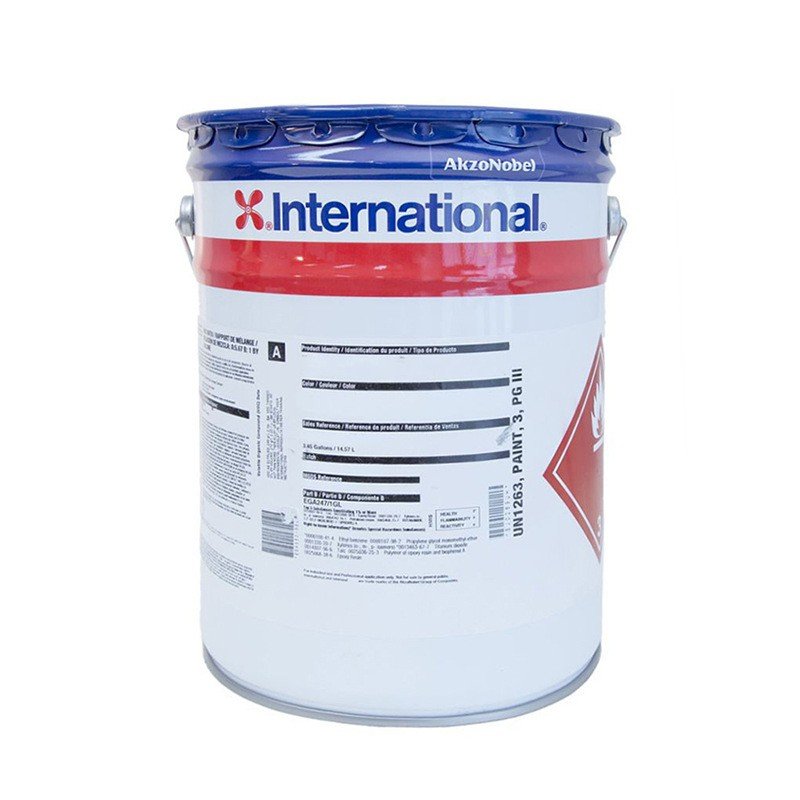
Interline 1064 Phenolic Vinyl Ester is a glass flake coating in the phenolic system. Interline 1064 is mainly used as a lining for chemical storage tanks and vessels, suitable for steel structures storing acidic chemicals or high-temperature media, such as in petroleum, natural gas and chemical processing plants, paper mills and other environments frequently in contact with corrosive chemicals. A two-component, chemical-resistant, abrasion-resistant, glass-flake-reinforced vinyl ester coating. The upper continuous curing temperature of the paint is 160 °C (320 °F). The maximum immersion temperature of Interline 1064 is 90 °C (194 °F). Parameters on this page: volume solids 100% active, dry film thickness 400–500 µm (16–20 mil), theoretical spreading rate 2.13 m²/L.
Source: AkzoNobel original technical data sheet (TDS) "Interline 1064 Phenolic Vinyl Ester"; spreading rate and other values are converted from TDS parameters and are for selection reference only.
The above content is compiled from the manufacturer's datasheet and this site's parameter tables. For selection, coating systems and lead times, pleaseContact Usfor confirmation.
This page carries the full TDS for this product, translated from the manufacturer's original document. No file download is needed; for an original-language copy, send an enquiry.
| Volume Solids | 100% active |
|---|---|
| Dry Film Thickness | 400–500 µm (16–20 mil) |
| Theoretical Spreading Rate | 2.13 m²/L |
| VOC | 2.06 lb/gal (248 g/L) US EPA Method 24 coating… |
| Density / Specific Gravity | 1.26 kg/L (10.5 lb/gal) |
| Number of Components | Two-component |
| Thinner | Must not be thinned |
| Mixing Ratio | 51.22 parts : 1 part (by volume) |
| Colour / Appearance | White, pale yellow, grey, INTERLINE 1064 |
For more Q&A on selection, application, acceptance and defect diagnosis, seeFAQsection.
A two-component, chemical-resistant, abrasion-resistant, glass-flake-reinforced vinyl ester coating.
Interline 1064 is mainly used as a lining for chemical storage tanks and vessels, suitable for steel structures storing acidic chemicals or high-temperature media, such as in petroleum, natural gas and chemical processing plants, paper mills and other environments frequently in contact with corrosive chemicals.
| Colour | White, pale yellow, grey, INTERLINE 1064 |
|---|---|
| Gloss | Semi-gloss |
| Volume Solids | 100% active |
| Typical thickness | Dry film 400–500 µm (16–20 mil), equivalent to wet film 471–588 µm (18.8–23.5 mil) |
| Practical Spreading Rate | At 400 µm dry film thickness and 85% volume solids, the theoretical spreading rate is 2.13 m²/L. At 16 mil dry film thickness and 85% volume solids, the theoretical spreading rate is 85 ft²/US gal. (For further details, see the "Product Characteristics" section.) |
| Application Methods | Suitable for airless spray and brush. Drying time: recommended topcoat overcoating interval |
| Temperature | Surface Dry | Hard Dry | Minimum | Maximum |
| 10°C (50°F) | 5 h | 6 h | 28 days | |
| 25°C (77°F) | 2 h | 4.5 h | 5 h | 28 days |
| 35°C (95°F) | 1.5 h | 2.5 h | 5 h | 28 days |
| Flash point (typical) | Component A 32 °C (90 °F); Component B 57 °C (135 °F); mixed 32 °C (90 °F) |
|---|---|
| Product weight | 1.26 kg/L (10.5 lb/gal) |
| Volatile Organic Compounds | 2.06 lb/gal (248 g/L) US EPA Method 24. Coating hazards: GB 30981.2-S-Pb≤1000-NC. Complies with GB 30981.2-2025. For further details, see the "Product Characteristics" section. |
All surfaces to be coated must be clean, dry and free of contaminants. Before application, all surfaces must be assessed and prepared in accordance with ISO 8504:2000. Remove oil and grease in accordance with the SSPC-SP1 solvent cleaning standard.
Steel structures: abrasive blast clean to Sa 2½ (ISO 8501-1:2007) or SSPC-SP6 (blast to SSPC-SP10 for ideal performance). If oxidation occurs between blasting and application of Interline 1064, the surface shall be re-blasted to the specified visual standard.
Surface defects exposed during abrasive blasting must be ground, filled or treated by a suitable method.
Recommended angular surface roughness of 75–100 µm (3–4 mils).
Concrete substrates: Interline 1064 is also suitable for cementitious surfaces under certain conditions; for details, refer to the product application guide
| Mixing | This product is supplied in two containers forming one unit. Mix the two components in the specified ratio in one operation. Once mixed, use within the specified pot life. |
|---|
(1) Stir the base (Component A) with a power mixer.
(2) Mix all of the curing agent (Component B) with the base (Component A) and stir thoroughly with a power mixer.
| Mixing ratio | 51.22 parts : 1 part (by volume) |
|---|
| Pot life | 10°C (50°F) | 25°C (77°F) | 35°C (95°F) |
| 90 min | 55 min | 40 min |
| Suitable for airless spray | Recommended: nozzle diameter 0.89–1.09 mm (35–43 mil); total paint pressure at the nozzle not less than 211 kg/cm² (3000 psi) |
|---|---|
| Air Spray | Not recommended (with pressure pot) |
| Brush | Applicable — for small-area repair only | Typical thickness 75 µm (3.0 mils) |
| Roller application | Not recommended | |
| Thinner | Not recommended | Must not be thinned |
| Cleaner | International GTA853 | Note: clean all equipment immediately after use. |
| Interruption of work | Paint must not be left in hoses, spray guns or spray equipment. Flush all equipment thoroughly with International thinner. Once mixed, paint should not be resealed; if work is interrupted for too long, mix a fresh batch before resuming application. |
|---|---|
| Cleaning | Clean all equipment immediately after use with International GTA853. Periodic flushing of spray equipment during the working day is good practice. The number of flushings depends on the quantity sprayed, temperature and time elapsed, including delays. |
All surplus paint and empty containers must be disposed of in accordance with the appropriate local regulations/laws.
Before use, refer to the detailed Interline 1064 application procedure.
Higher storage temperatures shorten shelf life. Unpromoted Interline 1064, stored in original sealed containers below 20 °C (68 °F), remains stable for up to 6 months from the production date. Interline 1064 must not be stored in direct sunlight. It is recommended to keep the paint as cool as possible, and it may be refrigerated if required, to extend shelf life and pot time during airless spray application. The temperature of the paint increases after mixing; this is important to consider, so the recommended storage temperature range is 8–19 °C (46–66 °F).
For ideal performance, Interline 1064 must be applied in at least 2 coats, each 400 µm (16 mil), with a total dry film thickness of not less than 800 µm (32 mil).
Although Interline 1064 is 100% active, the practical volume solids may be lower depending on application conditions; International Paint recommends an estimated spreading rate value of 85%.
Apply by airless spray only. Other methods such as brush or roller may require more than one coat and are recommended only for small areas or initial stripe coating.
This product must not be thinned, because the use of thinner severely retards the curing process.
The temperature of the surface to be coated must be at least 3 °C (5 °F) above the dew point.
The maximum steel temperature during application is 60 °C (140 °F), and the maximum relative humidity during application and curing is 80%.
This product does not cure adequately below 5 °C (41 °F). For ideal performance, the curing ambient temperature should be above 15 °C (59 °F).
The upper continuous curing temperature of the paint is 160 °C (320 °F).
The maximum immersion temperature of Interline 1064 is 90 °C (194 °F).
For the temperature range of specific cargoes, consult International Paint.
Interline 1064 is not intended for use as a decorative topcoat; colour stability is difficult to achieve.
For storage of inorganic or organic acids, consult International Paint for specific advice on cargo compatibility, suitable coating schemes and procedures.
When the surface temperature exceeds 35 °C (95 °F) or is exposed to direct sunlight, Interline 1064 should be overcoated as soon as hard dry is reached, to avoid intercoat adhesion problems.
Note: VOC values are typical and for guidance only. They may vary with colour and general production tolerances.
Although the low-molecular-weight reactive additive becomes part of the film when cured under normal ambient conditions, analysis by EPA Method 24 shows that it also affects the VOC value.
Interline 1064 is normally applied directly to steel; however, it may also be applied over the following primers: Ceilcote 370HT Primer (for service conditions between 60 °C (140 °F) and 90 °C (195 °F)); Ceilcote 380 Primer (for service conditions not exceeding 60 °C (140 °F)). Interline 1064 is suitable for self-overcoating.
For other information, consult International Paint.
Consult International Paint to ensure Interline 1064 is suitable for contact with the product to be stored.
| For further information on the industry standards, terms and abbreviations used in this datasheet, see www.international-pc.com | In the following documents on the website: • Definitions and abbreviations • Surface preparation • Coating application • Theoretical and practical spreading rate. These sections are also available as separate publications on request. |
|---|
This product must be applied at the production site by professional applicators in accordance with the recommendations in this manual, the Material Safety Data Sheet and the instructions on the container label. Do not use this product without first reviewing the Material Safety Data Sheet (MSDS) that International Paint provides for its customers.
All work related to the application and use of this product must be carried out in accordance with the relevant national health, safety and environmental standards and regulations.
If welding or flame cutting is required on metal coated with this product, dust and fumes will be generated; use appropriate personal protective equipment and adequate local ventilation.
If in doubt about the suitability of this product for the intended use, consult AkzoNobel for further advice.
| Packaging Specifications | Component A | Component B | ||
| Volume | Packaging | Volume | Packaging | |
| 20 L | 19.6 L | 20 L | 0.4 L | 0.5 L |
For other packaging sizes, contact AkzoNobel.
| Packaging Specifications | Component A | Component B |
| 20 L | 26.5 kg | 0.5 kg |
| Shelf life | Can be stored for 6 months at 20 °C (68 °F). Inspection required thereafter. Store in a dry, cool environment, away from heat sources and sources of ignition. During storage and shipment, the temperature of the Interline 1064 initiator must not exceed 30 °C (90 °F). Refrigeration is recommended. Part A and Part B should be stored separately. |
|---|
© 2026/5/26 AkzoNobel. All rights reserved.
All registered trademarks mentioned in this publication are licensed to or owned by AkzoNobel.
www.international-pc.com
Information is subject to the manufacturer's latest version; the manufacturer's latest TDS prevails.
The technical parameters on this page are taken from the product's original manufacturer technical datasheet, the copyright of which belongs to the manufacturer. If a rights holder considers the presentation inappropriate, contact us for verification and handling.
Packaging specifications and batch lead times are subject to actual availability. PleaseContact Uscontact us for project-based calculation.