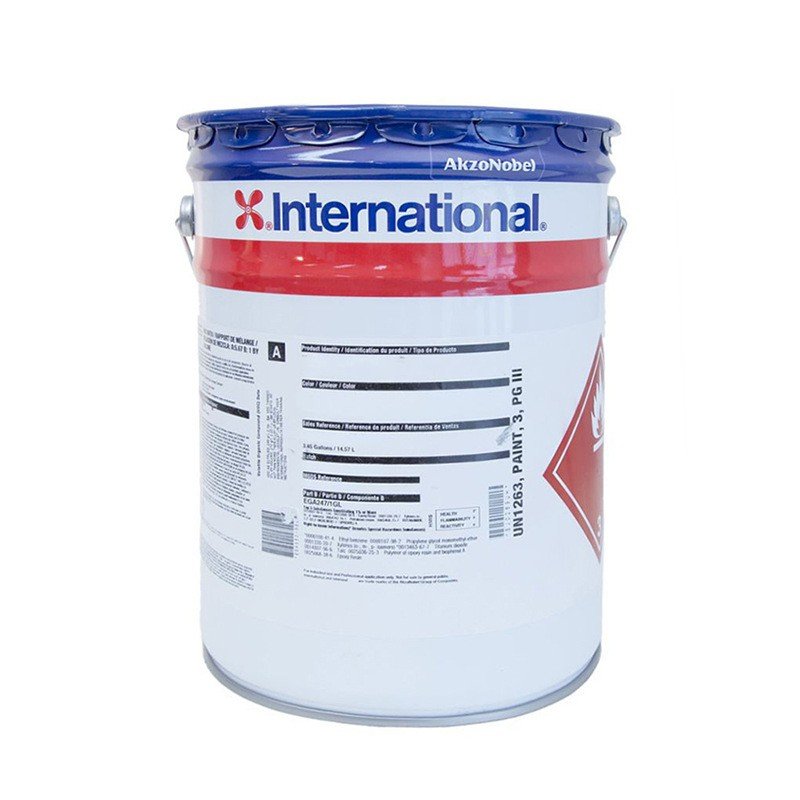
Intergard 242 Epoxy is an epoxy coating used as a primer. The product dries quickly, has short overcoating intervals, and can be overcoated with a wide range of coatings, making it an ideal primer before full-system application on site. Comparable models from the same brand: Intercure 1039 fast-drying epoxy primer, Intercure 200HS fast-drying epoxy primer, Intercure 200 fast-drying epoxy primer.
Parameter source: AKZONOBEL original technical data sheet (TDS) for Intergard 242 Epoxy; spreading rate and other values are converted from TDS parameters and provided for product selection reference only.
The above content is compiled from the manufacturer's datasheet and this site's parameter tables. For selection, coating systems and lead times, pleaseContact Usfor confirmation.
This page carries the full TDS for this product, translated from the manufacturer's original document. No file download is needed; for an original-language copy, send an enquiry.
| Volume Solids | — |
|---|---|
| Dry Film Thickness | — |
| Theoretical Spreading Rate | — |
| VOC | — |
| Density / Specific Gravity | — |
| Number of Components | — |
| Mixing Ratio | 4 parts : 1 part by volume |
A general-purpose two-component anticorrosive epoxy primer pigmented with zinc phosphate, complying with BS5493:1977.
For use as an industrial maintenance primer on suitably prepared surfaces. Suitable for a wide range of anticorrosive coating systems and for the offshore, petrochemical, chemical, pulp and paper, and bridge industries.
The product dries quickly, has short overcoating intervals, and can be overcoated with a wide range of coatings, making it an ideal primer before full-system application on site. The high abrasion resistance of Intergard 242 substantially reduces mechanical damage during transport from factory to site.
Intergard 242
| Colour | Dark yellow, oxide red |
|---|
| Gloss | Matt |
|---|---|
| Volume Solids | 53% |
| Standard Thickness | Dry film thickness 50-100 µm (2-4 mil), equivalent to wet film thickness 94-189 µm (3.8-7.5 mil) |
| Theoretical Spreading Rate | At the stated volume solids and 75 µm dry film thickness, 7.1 m²/L; at the stated volume solids and 3 mil dry film thickness, 283 ft²/US gal |
| Practical Spreading Rate | Allow for appropriate loss factors |
| Application Methods | Airless spray, air spray, brush, roller drying time overcoating interval with recommended topcoat |
| Temperature | Touch Dry | Hard Dry | Minimum | Maximum |
| 10°C( 50°F) | 6 h | 20 h | 24 h | Extendable* |
| 15°C( 59°F) | 3 h | 12 h | 16 h | Extendable* |
| 25°C( 77°F) | 1 h | 14 h | 12 h | Extendable* |
| 40°C( 104°F) | 30 min | 2 h | 8 h | Extendable* |
* See Definitions and Abbreviations published by International.
Flash Point
| Base (Component A) | Curing Agent (Component B) | Mixed |
| 24°C(75°F) | 27°C(81°F) | 24°C(75°F) |
| Product Weight | 1.5 kg/L (12.5 lb/gal) |
|---|---|
| Solvent Content | 465 g/L (3.88 lb/gal) UK - PG6/23(92), Appendix 3 2.80 lb/gal (336 g/L) USA - EPA Method 24 |
All surfaces to be coated must be clean, dry and free from contamination. Before painting, all surfaces must be assessed and treated in accordance with ISO 8504:1992. [DC1] Grease and oil must be removed in accordance with the SSPC-SP1 solvent cleaning requirements. [DC2] Blast cleaning must be carried out to Sa 2½ (ISO 8501-1:1988) or SSPC-SP6. If oxidation has occurred after blasting and before application of Intergard 242, the surface must be re-blasted to the specified visual standard.
Surface defects exposed by blast cleaning must be ground, filled or treated by a suitable method.
This product is not suitable for manually prepared steel surfaces. [AB4] Welds and damaged areas of shop-primed steel must be blast cleaned to Sa 2½ (ISO 8501-1:1988) or SSPC-SP6.
If the shop primer has sustained extensive or widely dispersed breakdown, a full sweep blast may be required.
[OP3]
| Mixing | The product is supplied in two containers forming one unit. A complete unit must always be mixed in the proportions supplied. Once mixed, the product must be used within the stated pot life. |
|---|
(1) Stir the base (Component A) with a power agitator.
(2) Combine the entire curing agent (Component B) with the base (Component A) and mix thoroughly with a power agitator.
| Mixing Ratio | 4 parts : 1 part by volume |
|---|
| Pot Life | 10°C(50°F) | 15°C(59°F) | 25°C(77°F) | 40°C(104°F) |
| 10 h | 8 h | 5 h | 2 h |
| Airless Spray | Recommended - nozzle tip 0.38-0.53 mm (15-21 mil) - total output fluid pressure at the nozzle not less than 176 kg/cm² (2,500 psi) |
|---|
| Air Spray | Recommended | Spray Gun | DeVilbiss MBC or JGA |
| (Pressure Pot) | Air Volume | 704 or 765 | |
| Spray Tip | E | ||
| Brush | Suitable — for small areas only | Standard thickness 40–50 µm (1.5–2.0 mil) | |
| Roller | Suitable — for small areas only | Standard thickness 40–50 µm (1.5–2.0 mil) | |
| Thinner | International GTA220 | Do not thin beyond the limits set by local environmental regulations. |
| Cleaner | International GTA220 |
|---|---|
| Paint Strip Blockage | Do not allow material to remain in hoses, spray guns or spraying equipment. Flush all equipment thoroughly with International GTA822. Once mixed, individual batches of coating must not be resealed. If application is interrupted for an extended period, use freshly mixed material when work resumes. [TC3] |
| Cleaning | Clean all equipment immediately after use with International GTA822. Periodic flushing of spray equipment during the working day is recommended. The frequency of cleaning depends on spray volume, temperature and elapsed time, including all delays. |
Dispose of surplus material and empty containers in accordance with the relevant regional regulations. [TC5]
Intergard 242 is preferred for use in systems in certain chemical environments where zinc-based materials may be attacked by acidic or alkaline conditions.
The maximum overcoating interval depends on the quality of the exposed film. A film of 75 µm (3 mil) dry film thickness can normally be overcoated after 6-12 months of exposure, provided it is thoroughly cleaned and any mechanical damage is repaired.
Excessive film thickness must be avoided, as aged thick films may impair the adhesion of subsequent coats more than films applied at the specified thickness. When used as a blast primer, avoid excessive thickness, since thick films may suffer cohesive film failure if subsequent coats are also applied too thickly.
Over-application of Intergard 242 will extend the minimum overcoating time and handling time and may adversely affect the long-term properties of subsequent coats.
Airless spray is the preferred method for achieving maximum film thickness in a single coat. Without airless spray, the required film build is unlikely to be obtained. Conventional spray may require multi-directional cross spraying to achieve maximum film thickness. At lower or higher temperatures, special application techniques may be required to obtain maximum film thickness.
When Intergard 242 is applied by brush or roller, multiple coats may be necessary to achieve the specified total system dry film thickness.
The product will not cure adequately at temperatures below 5 °C (41 °F). For optimum performance, the ambient curing temperature should be above 10 °C (50 °F).
The surface temperature must be maintained at least 3 °C (5 °F) above the dew point.
As with all epoxy coatings, Intergard 242 will chalk and fade on exposure. These effects do not, however, impair its anticorrosive performance.
Intergard 242 is not suitable for continuous immersion in water.
Where a durable high-gloss, non-fading decorative finish is required, overcoat with the recommended topcoat.
The product holds the following approvals: BS5493 (1977): KP1A; UK Department of Transport Item No. 111
Intergard 242 is normally suitable for application to suitably prepared steel, such as blast-cleaned steel. Where necessary, it may also be applied over prefabrication primers. Consult International for details.
Recommended intermediate coats/topcoats for use with Intergard 242 are as follows: Two-component topcoats:
| Interfine 629 HS | Intergard 735 | Intertuf 708 |
| Intergard 251 | Intergard 740 | Interzone 505 |
| Intergard 400 | Interplus 770 | Interzone 954 |
| Intergard 401 | Interplus 880 | Interthane 831 |
| Intergard 410 | Interseal 670 HS |
|---|---|
| Intergard 475 HS | Interthane 990. The following single-component coatings are also suitable: |
| Intercryl 525 | Interprime 466 |
| Intercryl 700 | Intersheen 73, Interlac 658, Interprime 205, Interprime 306. For other suitable intermediate coats/topcoats, consult International. |
For definitions of the industry standards, terms and abbreviations used in this data sheet, refer to the following sections of the International manual: Definitions and Abbreviations, Surface Preparation, Application, Theoretical and Practical Spreading Rates. These sections are available as separate leaflets on request.
The product must be used only in production areas by professional applicators, in accordance with the recommendations in this data sheet, the material safety data sheet and the container instructions. The product must not be used without reference to the material safety data sheet (MSDS), which has been provided to users by International.
All work involving the application and use of this product must be carried out in accordance with all relevant national health, safety and environmental standards and regulations.
Welding or flame cutting on metal coated with this product will produce dust and fumes, and suitable personal protective equipment and adequate local exhaust ventilation must therefore be used.
If in doubt about the suitability of this product, consult International for details.
| 20 L unit | Intergard 242 Base: 20 L container, filled with 16 L. Intergard 242 Curing Agent: 15 L container, filled with 4 L. For other sizes, consult International. |
|---|
| U.N. Shipping No. | 1263 |
|---|---|
| 20 L unit | 27.7 kg (61.1 lb) base (Component A) 4.2 kg (9.3 lb) curing agent (Component B) |
| Shelf Life | Shelf life of 18 months at 25 °C (77 °F). The product should then be re-checked. Store in a dry, shaded place away from sources of heat and ignition. |
|---|
The information in this data sheet is not necessarily exhaustive. Any use of the product for purposes other than those expressly recommended in this data sheet, without first obtaining written confirmation from the Company as to the suitability of the product for the intended use, is at the user's own risk. All warranties, whether express or implied, and the specific terms of sale are contained in the Company's Conditions of Sale, available on request. While every effort is made to ensure that all recommendations given about the product (in this data sheet or otherwise) are correct, the quality and condition of the substrate and the many factors affecting the use and application of the product are beyond the control of the Company. Accordingly, unless expressly agreed in writing, the Company accepts no liability for the performance of the product or for any loss or damage arising from its use, except death or personal injury caused by the Company's negligence. The data in this data sheet are subject to modification from time to time in line with experience and the Company's policy of continuous product development.
It is the user's responsibility to check that this data sheet is the latest version before using the product. Issue date: October 1998
© and International are trademarks.
Street
| World Headquarters | Asia | Australasia | Europe | Middle East | North America | South America |
| 50 George | 3 Neythal Road | 115 Hyde Road | 50 George Street | PO Box 37 | 6001 Antoine Drive | Rua Gomes de Carvalho, 1356, |
| London W1A 2BB | Jurong Town | Yeronga | London W1A 2BB | Dammam 31411 | Houston | 15°Andar, Vila Olímpia, |
| England | Singapore 628570 | Brisbane | England | Saudi Arabia | Texas 77091 | São Paulo, S.P. |
| Queensland | CEP: 04547-005 |
Australia
| Tel: (44) 171 612 1400 | Tel: (65) 663 3066 | Tel: (61) 7 3892 8866 | Tel: (44) 171 612 1410 Tel: (966) 3 842 8436 Tel: (1) 713 682 1711 | Tel: (011) 3044 0344 |
| Fax: (44) 171 612 1561 | Fax: (65) 266 5287 | Fax: (61) 7 3892 4287 | Fax: (44) 171 612 1555 Fax: (966) 3 842 4361 Fax: (1) 713 684 1327 | Fax: (011) 3044 0322 |
Health and Safety: (61) 1800 807 001
Information is subject to the manufacturer's latest version; the manufacturer's latest TDS prevails.
The technical parameters on this page are taken from the product's original manufacturer technical datasheet, the copyright of which belongs to the manufacturer. If a rights holder considers the presentation inappropriate, contact us for verification and handling.
For more Q&A on selection, application, acceptance and defect diagnosis, seeFAQsection.
Packaging specifications and batch lead times are subject to actual availability. PleaseContact Uscontact us for project-based calculation.