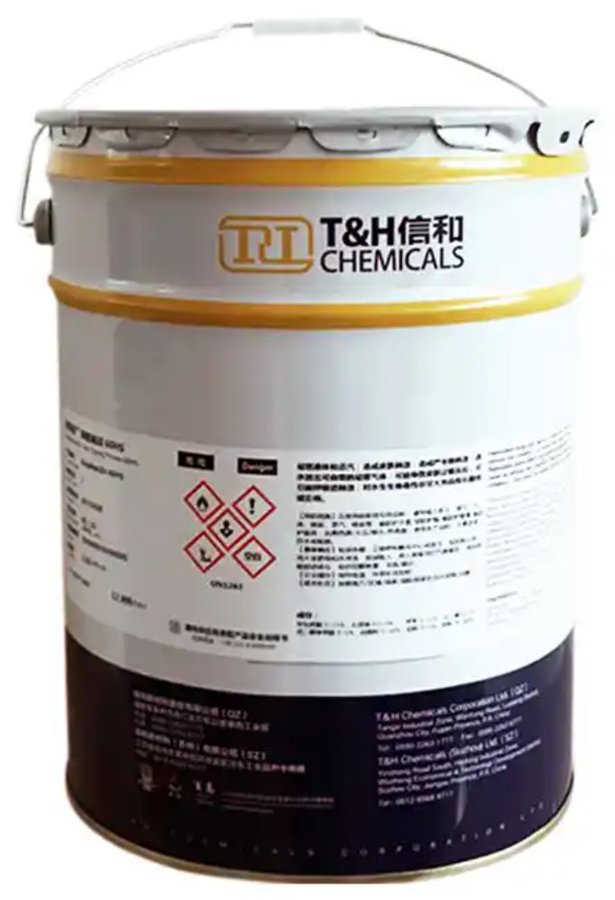
Tin-free Self-polishing Antifouling Paint XH5905 belongs to antifouling paints. Self-polishing is based on the formation of a hydrolysable active surface layer through ion exchange. Parameters on this page: volume solids 45 ± 2%, DFT 80/100/120 µm, theoretical spreading rate 3.75 m²/L.
Parameter source: T&H original technical data sheet (TDS) "Tin-free Self-polishing Antifouling Paint XH5905"; values such as spreading rate are converted from TDS parameters and are for selection reference only.
The above content is compiled from the manufacturer's datasheet and this site's parameter tables. For selection, coating systems and lead times, pleaseContact Usfor confirmation.
This page carries the full TDS for this product, translated from the manufacturer's original document. No file download is needed; for an original-language copy, send an enquiry.
| Volume Solids | 45 ± 2% |
|---|---|
| Dry Film Thickness | 80/100/120 µm |
| Theoretical Spreading Rate | 3.75 m2/L |
| VOC | 480g/L |
| Density / Specific Gravity | 1.55 kg/L |
| Number of Components | One-component |
| Flash Point | 27°C |
| Thinner | 0-5% |
| Colour / Appearance | Red |
For more Q&A on selection, application, acceptance and defect diagnosis, seeFAQsection.
Curing agent: none
A tin-free self-polishing antifouling paint based on functional acrylic resin. Self-polishing is based on the formation of a hydrolysable active surface layer through ion exchange. Inorganic fibres added to the coating ensure mechanical strength and prevent cracking and peeling. This product does not contain organotin compounds as biocides.
| Colour | Red |
|---|---|
| Gloss | Flat |
| density | 1.55 kg/L |
| Volume Solids | 45±2% |
| Volatile Organic Compounds | 480g/L |
| Flash Point | 27°C |
| Typical dry film thickness | 100µm |
|---|---|
| Recommended dry film thickness | 90–120 µm, depending on design life requirements |
| Thinner quantity (by volume) | Airless spray 0–5% | Air spray - | Roller or brush 0–5% |
| Recommended nozzle size | 0.69~0.79mm | - | / |
| Recommended spray pressure | 20~27MPa | - | / |
| Application suitability | Recommended | - | Suitable for small-area repair |
| Dry film thickness (µm) | 80 | 100 | 120 |
| Wet film thickness (µm) | 177 | 222 | 266 |
| Theoretical spreading rate (m²/L) | 5.6 | 4.5 | 3.75 |
| Existing old self-polishing antifouling paint or ablative antifouling paint | Remove grease with a suitable cleaner, then wash with high-pressure fresh water. |
|---|
To thoroughly remove all loosely adherent leached layer. Sealer: whether a sealer or tie coat is used depends on the type and condition of the existing antifouling paint.
1. Apply to a clean surface with temperature above the dew point to avoid condensation. Provide adequate ventilation during application and drying in confined spaces. 2. This product contains heavy pigment particles; stir thoroughly before use. During service, the product gradually erodes by continuously providing an active surface. Colour/colour stability: the same colour code may show colour variation. The final colour will appear as the colour after exposure to seawater. This has no effect on antifouling performance. 3. Remove the filter screen from the buffer tank and the filter screen in the spray gun.
4. Minimum undocking time depends on the number of coats, film thickness, temperature at the time and subsequent exposure/service conditions; refer to the corresponding paint scheme. Maximum undocking time depends on atmospheric conditions (such as UV radiation, temperature and atmospheric pollution level). Generally, exposure to the atmosphere for up to 6 months is acceptable, but in heavily polluted conditions high-pressure fresh water washing may be required; contact the Company for details. 5. On re-docking, after carefully removing loose matter from the antifouling paint coating, this product may be applied as a recoat. 6. Refer to the corresponding application instructions according to the existing hull condition, navigation mode and expected service life. There is no maximum recoat interval, but after long-term exposure in a polluted environment, the paint surface shall be cleaned with high-pressure fresh water. 7. Aluminium hull: if an effective anticorrosive scheme of at least two coats at 150 µm per coat is applied, this product may be applied to aluminium hulls. During service, the anticorrosive scheme must maintain film integrity to avoid aluminium corrosion caused by cuprous oxide contained in this product. 8. All equipment shall be cleaned with thinner immediately after use. Periodic flushing of spray equipment during daily work is good practice. Cleaning frequency depends on spray volume, temperature and spraying time, including interruption time. 9. Residual paint and empty cans shall be disposed of in accordance with relevant regional regulations.
20kg
Keep sealed in a ventilated, cool, dry place away from sources of ignition. Minimum 12 months.
1. Refer to the safety table and safety data of related materials for the paint and recommended thinner. This is a solvent-borne paint; inhalation of paint mist and solvent must be avoided, skin and eye exposure should be minimised, and contact with wet paint shall be avoided. 2. All work related to application and use of this product shall be carried out in accordance with relevant national health, safety and environmental standards and regulations. 3. Welding or flame cutting on metal coated with this product generates dust and fumes; suitable personal protective equipment and adequate local ventilation are required. 4. If there is doubt about the suitability of this product, consult the Company. Note: Lay-up: due to differences in seawater temperature, marine organisms and other factors in different sea areas, the requirements for lay-up period differ; generally, when vessel lay-up exceeds 14 days, antifouling performance may decrease.
The information provided in this product data sheet is based on laboratory test results that we consider accurate, and is provided for application guidance only. All recommendations and advice given by T&H on the use of T&H products, whether in technical documents, special consultation or otherwise, are based on information we consider most reliable. Our products and the information provided are intended for users with the necessary knowledge and industrial experience, and it is for these end users to determine whether the products are suitable for their use. T&H cannot control the quality and condition of the substrate, nor the various factors affecting the use of the product. Therefore, T&H accepts no liability for any loss, injury or damage arising from the use of our products or from reliance on this product data sheet (unless otherwise agreed in writing). Data in this product data sheet may be revised as necessary based on practical experience and continued product development.
Information is subject to the manufacturer's latest version; the manufacturer's latest TDS prevails.
The technical parameters on this page are taken from the product's original manufacturer technical datasheet, the copyright of which belongs to the manufacturer. If a rights holder considers the presentation inappropriate, contact us for verification and handling.
Packaging specifications and batch lead times are subject to actual availability. PleaseContact Uscontact us for project-based calculation.