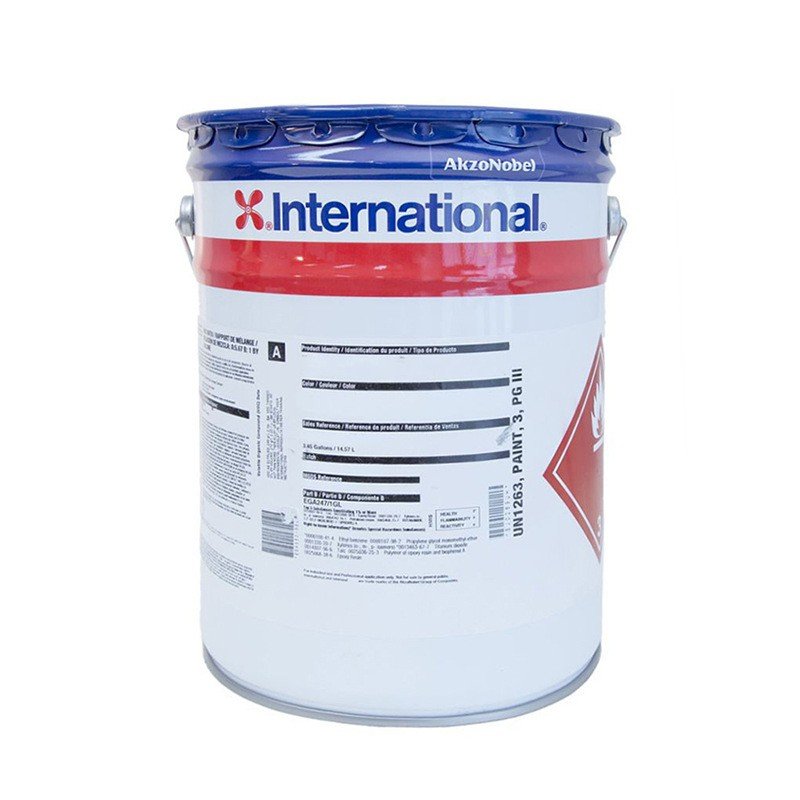
Interzinc 52 Epoxy Zinc-rich Primer belongs to zinc-rich primers, epoxy system. This is a high-performance primer which, as part of an anti-corrosive coating system, provides ideal protection in various severe corrosive environments, including: offshore structures, petrochemical plants, paper mills, bridges and power plants. A two-component epoxy zinc-rich primer complying with the composition and performance requirements of SSPC Paint 20. Over-application shall be avoided as far as possible to prevent impairment of intercoat adhesion with the subsequent film; dry spray shall also be avoided to prevent pinholes in the subsequent coat. Parameters on this page: volume solids 59% ± 2%, dry film thickness 50–75 µm (2–3 mils), theoretical spreading rate 7.87 m²/L.
Parameter source: AKZONOBEL original technical data sheet (TDS) 'Interzinc 52 Epoxy Zinc-rich Primer'; values such as spreading rate are converted from TDS parameters and are for product selection reference only.
The above content is compiled from the manufacturer's datasheet and this site's parameter tables. For selection, coating systems and lead times, pleaseContact Usfor confirmation.
This page carries the full TDS for this product, translated from the manufacturer's original document. No file download is needed; for an original-language copy, send an enquiry.
| Volume Solids | 59% ± 2% |
|---|---|
| Dry Film Thickness | 50–75 µm (2–3 mils) |
| Theoretical Spreading Rate | 7.87 m²/L |
| VOC | 2.80 lb/gal (336 g/L) US EPA Method 24 15… |
| Density / Specific Gravity | 2.52 kg/L (21.0 lb/gal) |
| Number of Components | Two-component |
| Thinner | Normally no thinning is required |
| Mixing Ratio | 4 parts : 1 part (by volume) |
| Colour / Appearance | Blue, grey, green — colour availability varies by region, INTERZINC 52 |
For more Q&A on selection, application, acceptance and defect diagnosis, seeFAQsection.
A two-component epoxy zinc-rich primer complying with the composition and performance requirements of SSPC Paint 20.
This is a high-performance primer that, as part of an anticorrosive coating system, provides protection in various severely corrosive environments, including offshore structures, petrochemical plants, paper mills, bridges and power plants.
Interzinc 52 can be used for the maintenance and repair of existing metal structures and also provides new structures with excellent anti-corrosive performance.
| Colour | Blue, grey, green — colour availability varies by region, INTERZINC 52 |
|---|---|
| Gloss | Matt |
| Volume Solids | 59% ± 2% |
| Typical thickness | DFT 50–75 µm (2–3 mil) corresponds to WFT 85–127 µm (3.4–5.1 mil) |
| Theoretical Spreading Rate | 7.87 m²/L at 75 µm dry film thickness and the stated volume solids; 315 ft²/US gal at 3 mil dry film thickness and the stated volume solids |
| Practical Spreading Rate | Allowing for a suitable loss factor |
| Application Methods | Airless spray, air spray, brush. Drying time; recommended topcoat recoat interval |
| Temperature | Surface Dry | Hard Dry | Minimum | Maximum |
| 5°C (41°F) | 2 h | 10 h | 8 h | Unlimited¹ |
| 15°C (59°F) | 90 min | 6 h | 4 h | Unlimited¹ |
| 25°C (77°F) | 75 min | 4 h | 3 h | Unlimited¹ |
| 40°C (104°F) | 45 min | 2 h | Unlimited¹ | |
¹ See the Definitions and Abbreviations of the International Paint Protective Coatings Division. For low-temperature curing, other hardeners are available. For details, see the 'Product Characteristics' section.
When a polysiloxane topcoat is used, the maximum recoating interval will be shortened. For details, consult International Paint.
| Flash point (typical) | Component A 29 °C (84 °F); Component B 30 °C (86 °F); mixed 29 °C (84 °F) |
|---|---|
| Product weight | 2.52 kg/L (21.0 lb/gal) |
| Volatile Organic Compounds | 2.80 lb/gal (336 g/L) US EPA Method 24 152 g/kg EC Solvent Emissions Directive content (Council Directive 2010/75/EU) 360 g/L Chinese national standard GB 23985 coating hazard GB 30981.2-S-Pb≤1000-NC complies with GB 30981.2-2025. For further details, see the section on 'Product Characteristics'. |
All surfaces to be coated must be clean, dry and free of contaminants. Before application, all surfaces must be assessed and prepared in accordance with ISO 8504:2019.
Oil and grease must be removed in accordance with the SSPC-SP1 solvent cleaning standard.
Blast-cleaned steel: blast clean the surface to Sa2½ (ISO 8501-1:2007) or SSPC-SP6. If oxidation occurs between blast cleaning and application of Interzinc 52, re-blast the surface to the specified visual standard.
Surface defects exposed by blast cleaning must be ground, filled or treated by a suitable method.
Recommended surface profile 40–75 µm (1.6–3.0 mil).
Shop-primed steel structures: Interzinc 52 is suitable for application on steel structures with freshly applied zinc silicate shop primer. If the zinc silicate shop primer shows extensive scattered detachment or excessive zinc salts, sweep blasting is required. Other types of shop primer are not suitable for overcoating and require thorough blast cleaning;
Welds and damaged areas shall be prepared to at least St3 (ISO 8501-1:2007) or SSPC-SP3. Blast cleaning to Sa2½ (ISO 8501-1:2007) or SSPC-SP6 gives optimum performance. If this cannot be achieved, power-tool cleaning to SSPC-SP11 is recommended.
| Mixing | This product is supplied in two containers forming one unit. Mix the two components in the specified ratio in one operation. Once mixed, use within the specified pot life. |
|---|
(1) Stir the base (Component A) with a power mixer.
(2) Mix all of the curing agent (Component B) with the base (Component A) and stir thoroughly with a power mixer.
| Mixing ratio | 4 parts : 1 part (by volume) |
|---|
| Pot life | 5°C (41°F) | 15°C (59°F) | 25°C (77°F) | 40°C (104°F) |
| 24 h | 12 h | 5 h | 2 h |
| Suitable for airless spray | Recommended: nozzle diameter 0.43–0.53 mm (17–21 thousandths of an inch); total paint pressure at the nozzle not less than 176 kg/cm² (2503 psi) |
|---|
| Air Spray | Recommended | Spray gun | DeVilbiss MBC or JGA |
| Air nozzle | 704 or 765 | ||
| (with pressure pot) | Nozzle | E | |
| Brush | Applicable — for small-area repair only | Typical thickness 50–75 µm (2.0–3.0 mils) | |
| Roller application | Not recommended | ||
| Thinner | International GTA220 | Normally no thinning is required. |
(or International. In extreme cases, consult the local technical representative.
GTA415). Do not thin beyond the requirements of local environmental regulations.
| Cleaner | Use a cleaning solvent that complies with local regulations. Consult the local representative for specific recommendations. |
|---|---|
| Interruption of work | Do not leave paint in hoses, spray guns or spray equipment. Flush all equipment thoroughly with International thinner. |
Mixed paint should not be resealed. If work is interrupted for too long, mix a fresh batch of paint for application.
| Cleaning | All equipment should be cleaned immediately after use with International thinner. Flushing spray equipment periodically during daily work is good practice. Cleaning frequency depends on the volume sprayed, temperature, spraying time, including delays, and other factors. |
|---|
All surplus paint and empty containers must be disposed of in accordance with the appropriate local laws/regulations.
To ensure good corrosion resistance, Interzinc 52 must achieve a minimum dry film thickness of 40 µm (1.5 mils). To obtain a uniform, cohesive and sealed film at this dry film thickness, Interzinc 52 must be thinned 10% with International brand thinner. The film thickness of the applied Interzinc 52 must be matched to the surface profile achieved by surface preparation. Low film thickness should not be applied on surfaces with high roughness.
Care should be taken to avoid applying a dry film thickness exceeding 150 µm (6 mils). Over-application should be avoided as it affects intercoat adhesion with the subsequent coat; dry spray should also be avoided to prevent pinholes in the next coat. Over-application also leads to reduced curing speed and extended handling and recoating times.
Over-application of Interzinc 52 extends the minimum recoating time and handling time, adversely affecting long-term recoating performance.
When Interzinc 52 is allowed to weather before topcoating, ensure that all zinc salts are removed before painting, and apply the topcoat using only recommended materials.
The temperature of the surface to be coated must be at least 3 °C (5 °F) above the dew point.
Interzinc 52 is generally not recommended for underwater use unless specifically approved. Consult International Paint to confirm the intended specification and service conditions.
Interzinc 52 is suitable for spot repair of damaged inorganic zinc primers - consult International Paint Industrial Coatings for specific recommendations.
Low-temperature curing: if the temperature is below 5 °C (41 °F), an alternative low-temperature curing agent may be used. When this low-temperature curing agent is selected, note that VOC will increase to 384 g/L (EPA Method 24) and the flash point of Component B is 24 °C (79 °F).
Interzinc 52 can cure below 0 °C (32 °F). However, the product should not be applied at 0 °C (32 °F) because ice may be present on the substrate.
| Temperature | Surface Dry | Hard Dry | Minimum | Maximum | Pot life |
| -5°C (23°F) | 3 h | 31 h | Unlimited* | 18 h | |
| 0°C (32°F) | 2.5 h | 16 h | Unlimited* | 18 h | |
| 5°C (41°F) | 30 min | 4 h | Unlimited* | 18 h | |
| 15°C (59°F) | 20 min | 3.5 h | Unlimited* | 8 h | |
| 25°C (77°F) | 15 min | 3 h | Unlimited* | 2.5 h | |
The touch-dry times in the table above are chemical curing times, not the physical film-forming curing times at temperatures below 0 °C (32 °F).
Refer to the Definitions and Abbreviations of International Paint's Industrial Protective Coatings department for details on curing time and recoating; contact International Paint Industrial Coatings.
This product is certified to the following specifications: • Steel Structures Painting Council - SSPC Paint 20. After consulting International Paint's Industrial Protective Coatings department, this paint may be applied by other relevant application methods such as flow coating.
Note: VOC values are typical and for guidance only. They may vary with colour and general production tolerances.
Although the low-molecular-weight reactive additive becomes part of the film when cured under normal ambient conditions, analysis by EPA Method 24 shows that it also affects the VOC value.
Interzinc 52 is designed for application on suitably prepared steel and may also be applied on approved shop primers. Details on these aspects are available from International Paint Industrial Coatings
| Company. | Recommended topcoats: |
|---|---|
| Intercure 200 | InterH2O 401 |
| Intercure 420 | Interseal 670HS |
| Interfine 629HS | Interthane 990 |
| Intergard 251 | Interthane 990E |
| Intergard 269 | Interzone 1000 |
| Intergard 475HS | Interzone 505 |
| Intergard 740 | Interzone 954. For other suitable topcoats, consult International Paint Protective Coatings |
| For further information on the industry standards, terms and abbreviations used in this datasheet, see www.international-pc.com | In the following documents on the website: • Definitions and abbreviations • Surface preparation • Coating application • Theoretical and practical spreading rate. These sections are also available as separate publications on request. |
|---|
This product must be applied at the production site by professional applicators in accordance with the recommendations in this manual, the Material Safety Data Sheet and the instructions on the container label. Do not use this product without first reviewing the Material Safety Data Sheet (MSDS) that International Paint provides for its customers.
All work related to the application and use of this product must be carried out in accordance with the relevant national health, safety and environmental standards and regulations.
If welding or flame cutting is required on metal coated with this product, dust and fumes will be generated; use appropriate personal protective equipment and adequate local ventilation.
If in doubt about the suitability of this product for the intended use, consult AkzoNobel for further advice.
| Packaging Specifications | Component A | Component B | ||
| Volume | Packaging | Volume | Packaging | |
| 10 L | 8 L | 10 L | 2 L | 2.5 L |
| 3 US gal | 2.4 US gal | 3.5 US gal | 0.6 US gal | 1 US gal |
For other packaging sizes, contact AkzoNobel.
| Packaging Specifications | Component A | Component B |
| 10 L | 24.5 kg | 2.1 kg |
| 3 US gal | 63.3 lb | 5.3 lb |
| Shelf life | At least 12 months at 25 °C (77 °F). Thereafter, inspection is required. Store in a dry, cool environment away from heat and sources of ignition. |
|---|
© 2026/5/27 AkzoNobel. All rights reserved.
All registered trademarks mentioned in this publication are licensed to or owned by AkzoNobel.
www.international-pc.com
Information is subject to the manufacturer's latest version; the manufacturer's latest TDS prevails.
The technical parameters on this page are taken from the product's original manufacturer technical datasheet, the copyright of which belongs to the manufacturer. If a rights holder considers the presentation inappropriate, contact us for verification and handling.
Packaging specifications and batch lead times are subject to actual availability. PleaseContact Uscontact us for project-based calculation.
The factory item numbers for Interzinc 52 Epoxy Zinc-rich Primer are as follows.Item No.is the most accurate form when ordering;Colour/colour codecorresponds to the actual colour (RAL, GSB are colour chart codes);Packaging SpecificationsFactory complete-set specification format. Colors not listed may be ordered against the colour card.
| Item No. | Colour / colour code | Packaging Specifications |
|---|---|---|
| EPA178 | Grey | 10 L |
This model has a total of1item numbers, all listed on this page; colours outside the table (including special colours and bulk packaging) can be confirmed by phone, delivery dates are advised according to the factory's current production schedule and stock. In the packaging specification, the "+" indicates the complete-set notation for two-component products (base + curing agent), subject to the factory specification; a "—" in the colour column denotes an auxiliary product, or that the item has no colour code in the factory system.