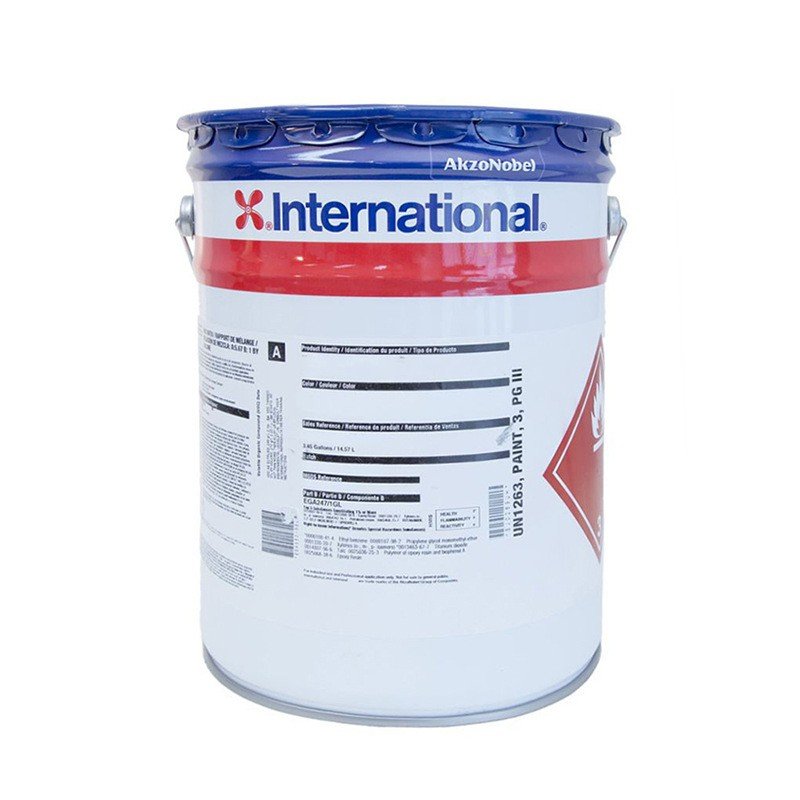
Interline 961 two-component solvent-borne phenolic resin tank coating belongs to phenolic paints. It is suitable for hot water at 95°C (203°F) and for the storage of many other products, such as aliphatic and aromatic solvents, aviation fuel, unleaded gasoline, and brine. 961 is suitable for equipment exposed to acidic and corrosive environments, including hot steel pipes under insulation, buried pipelines, and underwater pipelines, with a maximum service temperature of 95°C (203°F). This is a two-component solvent-borne phenolic resin tank coating suitable for new steel or surfaces with slight rust. Repaired areas should be retested and cured according to the preceding procedure before being placed into service. Parameters on this page: DFT 100-125 µm (45 mil), number of components: two-component.
Parameter source: AKZONOBEL original technical data sheet (TDS) 'Interline 961 Two-component Solvent-borne Phenolic Resin Tank Coating'; values such as spreading rate are converted from TDS parameters and are for selection reference only.
The above content is compiled from the manufacturer's datasheet and this site's parameter tables. For selection, coating systems and lead times, pleaseContact Usfor confirmation.
This page carries the full TDS for this product, translated from the manufacturer's original document. No file download is needed; for an original-language copy, send an enquiry.
| Volume Solids | 50% |
|---|---|
| Dry Film Thickness | 100-125 µm (45 mil) |
| Theoretical Spreading Rate | 4.00 m²/L |
| VOC | — |
| Density / Specific Gravity | 1.5 kg/L (12.4 lb/gal) |
| Number of Components | Two-component |
| Thinner | Do not exceed the thinning limits of local environmental regulations |
| Mixing Ratio | By volume 1.85:1 |
| Colour / Appearance | Pale yellow, grey, white |
For more Q&A on selection, application, acceptance and defect diagnosis, seeFAQsection.
Protective Coatings
This is a two-component solvent-borne phenolic resin tank lining coating, suitable for new steel or surfaces with slight rust staining.
Particularly suitable for the storage of hot water up to 95°C (203F), and also suitable for the storage of many other products such as aliphatic and aromatic solvents, aviation fuel, unleaded petrol, brine and similar products.
| Interline | 961 is suitable for equipment exposed to acidic and corrosive environments, including hot steel pipes under insulation, buried pipes |
|---|---|
| or underwater pipelines; the maximum temperature resistance is | 95°C(203°F). |
| Colour | Pale yellow, grey, white |
| Gloss | Sheen |
|---|---|
| Volume Solids | 50% |
| Typical thickness | Dry film thickness 100-125 µm (45 mils), equivalent to wet film thickness 200-2.50 µm (8-10 mils) |
| Theoretical Spreading Rate | At the above volume solids and a dry film thickness of 125 µm, 4.00 m²/L; at the above volume solids and a dry film thickness of 5 mils, 160 ft²/US gallon |
| Practical Spreading Rate | Allow for an appropriate loss factor |
| Application methods | Airless spray, air spray, brush, roller; for drying time refer to the self-recoat interval |
| Temperature | Surface Dry | Hard Dry | Minimum | Maximum | |
| 10°C (500F) | 90 min | 8 h | 24 h | 7 days | |
| I5°C(59°F) | 60 min | 6 h | 24 h | 6 days | |
| 25°C(77°F) | 30 min | 4 h | 20 h | 5 days | |
| 40°C(104°F) | 20 min | 2 h | 16 h | 3 days | |
| Flash Point | Base (Component A) | Curing agent (Component B) | After mixing | ||
| 23°C(73°F) | 23°C (73°F) | 23°C( | 73°F) | ||
| Product weight | 1.5 kg/L (12.4 lb/gal) |
|---|---|
| Solvent content | 460 g/L (3.84 lb/gal) UK -PG623 (92), Appendix 3 |
| All surfaces to be coated shall be clean, dry and free from contamination. Prior to painting, all surfaces shall be assessed and prepared in accordance with ISO | 8504:1992. |
|---|
If necessary, remove weld spatter and grind weld seams and sharp edges smooth.
Blast cleaning
| This product may only be applied to surfaces blast cleaned to | Sa2/ (ISO 8501-1:1988) or SSPC-SP10. |
|---|---|
| The recommended surface profile is | 50-75 µm (2-3 mils). |
| Interline | 961 shall be applied before oxidation of the steel surface occurs. If oxidation does occur, the entire oxidized area shall be re-blast cleaned to the above standard. |
Surface defects exposed during blast cleaning shall be ground, filled or treated in an appropriate manner.
| Prior to the occurrence of oxidation, the surface may be primed with | Interline 961 (thinned 30% with GTA420) to a dry film thickness of 40 µm (1.5 mils). Dehumidification equipment may also be used to maintain the cleanliness standard after blast cleaning. |
|---|
High-temperature tanks
SSPC-SP10. Use Interline
| When maintaining high-temperature tanks, the substrate shall be prepared by blast sweeping to | Sa2 (ISO8501-1:1988) or | the SSPC-SP7 standard, | |
| and flushed thoroughly with fresh water to remove all salt, then dried and blast cleaned to | Sa2/(ISO | 8501-1:1988) | or |
| Mixing | 961, work shall be carried out in accordance with Interline | 961 system instructions and the International Paint |
Industrial Protective Coatings tank lining coating recommended procedure detailed steps.
This product is supplied in two cans forming one unit. The specified mixing ratio shall be followed each time, the components mixed in full at one time, and the mixture used within the specified pot life.
(1) Stir the base (A) with a power mixer.
(2) Stir the curing agent (B) with a power mixer.
(3) Combine the entire curing agent (B) with the base (A) and mix thoroughly with a power mixer.
| Mixing Ratio | By volume 1.85:1 |
|---|
| Pot life | 10°C(500F) | 15°C (59°F) | 25°C(77°F) | 40°C(104°F) |
| 5 h | 4 h | 2 h | 45 min |
| Airless spray | Recommended - nozzle tip size 0.53-0.68 mm (21-27 thou) - paint pressure at the nozzle not less than 141 kg/cm² (2,500 psi) |
|---|---|
| Air Spray | Recommended - spray gun DeVilbiss MBC or JGA |
| (with pressure pot) | Air 704 or 765 spray nozzle |
µm (1.5-2.0 mils)
| Brush | Suitable — for small areas only | Typical thickness 40-50 µm (1.5-2.0 mils) | |
| Roller application | Suitable — for small areas only | Typical thickness | 40-50 |
| Thinner | International GTA420 | Do not exceed the dilution limits specified by local environmental regulations. |
| Cleaner | International GTA853 |
|---|---|
| Interruption of work | Do not leave paint in hoses, spray guns or spray equipment. Flush all equipment thoroughly with International GTA853. Mixed paint should not be resealed. If work is suspended for an extended period, use freshly mixed paint when work resumes. |
| Cleaning | Clean all equipment with International GTA853 immediately after use. Periodic flushing of spray equipment during application is recommended. Cleaning frequency depends on spray volume, temperature and time, including all interruption periods. |
Surplus paint and empty containers must be disposed of in accordance with the relevant regional regulations.
| Refer before use to the detailed content of | the Recommended Procedure for Tank Lining Coatings. |
|---|---|
| Interline | 961 is normally applied as a two-coat system, each coat 125 µm (5 mils) thick, so that the total dry film |
| thickness can reach | 250 µm (10 mils). The exact total dry film thickness depends on the requirements of the end use. For specific recommendations on the application of tank lining coatings, consult International Paint Industrial Protective Coatings. |
Airless spray is the ideal means of achieving the maximum film thickness in a single coat. Without airless spray, obtaining the required film thickness is unlikely. Conventional spray may require multiple cross-spray passes to achieve the maximum film thickness. Other methods (brush, roller) may require more than one coat and are recommended only for small areas or initial precoating.
Areas with severe rust staining shall be precoated by brush to wet the surface effectively.
Surface temperature must be at least 3°C (5°F) above dew point.
| Do not apply if the steel temperature is below | 10°C (50°F). |
|---|
Exposure to excessively low temperature or high humidity during or immediately after application may result in incomplete curing and surface contamination, reducing intercoat adhesion.
| Application in confined or limited spaces | Adequate air circulation shall be maintained for Interline 961. |
|---|---|
| Interline | Excessive thickness of 961 will cause cracking. The film thickness of a single coat must be within the recommended limit. The total dry film thickness of multiple coats shall not exceed 350 µm. |
Maximum chemical resistance is achieved only after the film is fully cured. Factors affecting curing include temperature, humidity and film thickness.
Under normal conditions, a film of 250 µm (10 mils) dry film thickness cures fully in 7-10 days at 25°C (77F), at which point it has the desired chemical resistance. Curing time is proportional to temperature: higher temperature, shorter time; lower temperature, longer time.
Curing time varies with dry film thickness and the conditions during application and curing.
After the final coat has hardened, the dry film thickness of the complete coating system shall be measured with a suitable non-destructive thickness gauge to determine the average total thickness applied. The coating shall be free from pinholes and other misses. The cured film shall be essentially free from sags, runs, inclusions and other defects. All defects shall be remedied. Repaired areas shall be retested and cured in accordance with the above steps before being placed in service. For correct repair procedures, refer to the tank lining procedure of International Paint Industrial Protective Coatings.
| If the cargo temperature exceeds | 60°C (140°F), the tank must be insulated to prevent blistering (the 'cold wall' effect) caused by the temperature difference between the coating and the substrate, which may lead to premature coating failure. |
|---|
This product holds the following specification approval: Air BPFD specification - aviation fuel tank lining coating
This system is self-priming and is not suitable for application over other primers.
| Interline | 961 may only be recoated with itself to form the topcoat and must never be overcoated with other products. |
|---|---|
| Consult International Paint Industrial Protective Coatings to determine | whether Interline 961 is suitable for contact with the tank contents. |
Details of the industrial standards, terms and abbreviations referred to in this data sheet can be found in the following sections of International Paint Industrial Protective Coatings product data sheets: • Definitions and abbreviations • Surface preparation • Coating application • Practical and theoretical spreading rate. The following documents are available on request: • Recommended Procedure for Tank Lining Coatings
This product shall be used by professional coating applicators at the production site in accordance with the recommendations in this data sheet, the Material Safety Data Sheet and the instructions on the packaging container. This product shall not be used without reading the Material Safety Data Sheet (MSDS).
This data sheet has been supplied to the user by International Paint Industrial Protective Coatings.
All work involving the application and use of this product shall be carried out in accordance with all relevant national health, safety and environmental standards and regulations.
Welding or flame cutting of metal coated with this product will emit dust and fumes; suitable personal protective equipment and adequate local exhaust ventilation are therefore required.
If in doubt about the suitability of this product, consult International Paint Industrial Protective Coatings for details.
| 20 L pack | Interline 961 base: 20 L container containing 13 L; Interline 961 curing agent: 10 L container containing 7 L. For other sizes, consult International Paint Industrial Protective Coatings. |
|---|---|
| U.N. Shipping No. | 1263 |
| 20 L pack | 24.9 kg (54.9 lb) base (Component A); 8.3 kg (18.3 lb) curing agent (Component B) |
|---|
| Shelf life | Shelf life of at least 12 months at 25°C (77°F). Thereafter, inspect before use. Store in a dry, shaded place away from heat and ignition sources. |
|---|
The information provided in this data sheet may not be exhaustive. Any use of this product outside the scope expressly recommended in this data sheet, without prior written confirmation from the Company of the suitability of the product, shall be at the user's own risk. All warranties and specific terms of sale are set out in the International Paint Industrial Protective Coatings Sales Terms, available on request. While the Company endeavours to ensure that all advice given in respect of this product (in this data sheet or other materials) is correct, the quality and condition of the substrate and the many factors affecting the use and application of this product are beyond the control of the Company. Accordingly, unless the Company gives express written consent, the Company accepts no liability whatsoever for product performance, nor for any loss or damage arising from the use of this product (other than death or personal injury caused by the negligence of the Company). The information in this data sheet is subject to amendment from time to time in the light of practical experience and the Company policy of continuous product development.
Before using the product, the user is responsible for verifying that this data sheet is the latest version. Issue date: 19 June 2002. Copyright © International Paint Ltd. International is a trademark.
| Headquarters | Asia | Oceania | Region | Middle East | North America | South America |
| P.O. Box 20980 | 3 Neythal Road | 115 Hyde Road | P.O. Box 20980 | PO Box 37 | 6001 Antoine Drive | Av Paiva 999, |
| Oriel House | Jurong Town | Yeronga | Oriel House | Dammam 31411 | Houston | Neves, Sao Gongalo |
| 16 Connaught Place | Singapore 628570 | Brisbane | 16 Connaught Place | Saudi Arabia | Texas 77091 | Rio de Janeiro |
| London, W2 2ZB | Queensland | London, W2 2ZB | Brazil | |||
| England | Australia | England | ||||
| Telephone: (44) 20 7479 6000 | Tel: (65) 663 3066 | Tel: (61) 73892 8888 | Telephone: (44) 20 7479 6000 | Tel: (966)3 812 1044 | Tel: (55) 216247100 | |
| Fax: (44)20 7479 6500 | Fax: (65) 266 5287 | Fax: (61) 73892 4287 | Fax: (44)20 7479 6500 Fax: (966) 3812 1169 Fax: (1)713 684 1514 | Fax: (55) 216247123 |
Safety and Health: (61) 1800 807001
The text on this page was generated by OCR of the manufacturer's TDS; individual characters may differ from the original. The manufacturer's TDS prevails.
Data is subject to the manufacturer's latest version; in all cases the manufacturer's latest TDS prevails.
Packaging specifications and batch lead times are subject to actual availability. PleaseContact Uscontact us for project-based calculation.