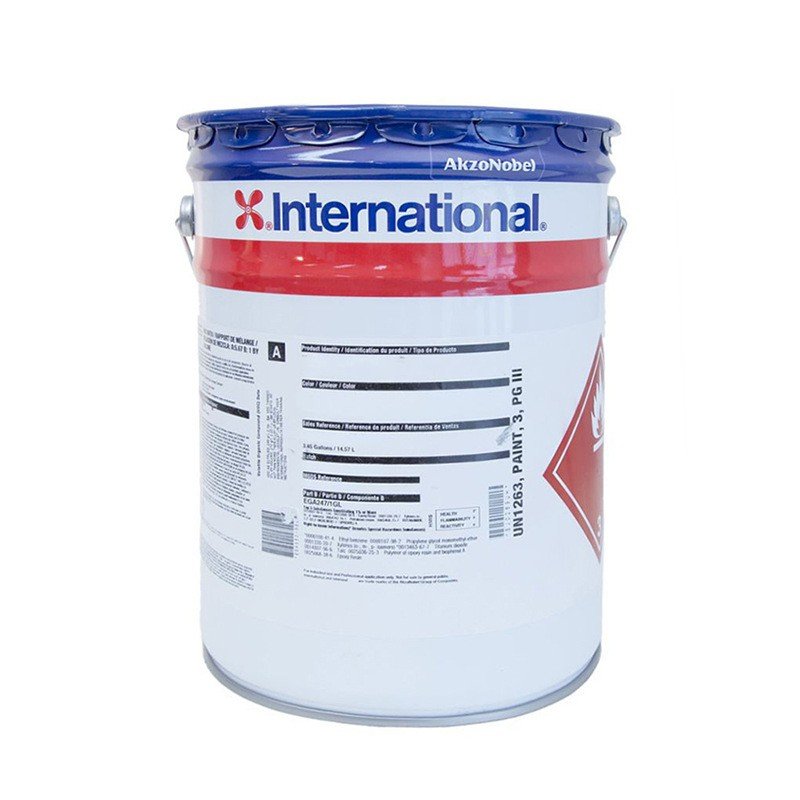
Interline 859 is an epoxy coating. It provides internal corrosion protection for steel storage tanks containing a variety of products where accumulation of static electricity may be a concern, such as crude oil, unleaded gasoline blends, MTBE, and aromatic and aliphatic solvents. A two-component, chemical-resistant, high-solids, high-build phenolic epoxy tank lining with static dissipation properties. Typically, at a total dry film thickness of 250 µm (10 mil), full cure and optimum chemical resistance are achieved after 7–10 days at 25 °C (77 °F) and 50% relative humidity. Parameters on this page: Dry Film Thickness 100–150 µm (4–6 mil), Theoretical Spreading Rate 6.08 m²/L, Number of Components two-component.
Parameter source: AKZONOBEL original technical data sheet (TDS) “Interline 859 (Epoxy Phenolic Resin Coating (Conductive))”; values such as spreading rate are converted from TDS parameters and are for selection reference only.
The above content is compiled from the manufacturer's datasheet and this site's parameter tables. For selection, coating systems and lead times, pleaseContact Usfor confirmation.
This page carries the full TDS for this product, translated from the manufacturer's original document. No file download is needed; for an original-language copy, send an enquiry.
| Volume Solids | 76% |
|---|---|
| Dry Film Thickness | 100–150 µm (4–6 mils) |
| Theoretical Spreading Rate | 6.08 m²/L |
| VOC | 1.87 lb/gal (225 g/L) US EPA Method 24… |
| Density / Specific Gravity | 1.48 kg/L (12.4 lb/gal) |
| Number of Components | Two-component |
| Thinner | Normally no thinning is required |
| Mixing Ratio | 4 parts : 1 part (by volume) |
| Colour / Appearance | Charcoal grey, INTERLINE 859 |
For more Q&A on selection, application, acceptance and defect diagnosis, seeFAQsection.
A two-component, chemical-resistant, high-solids, high-build phenolic epoxy lining with static dissipation.
For corrosion protection of the inner walls of steel tanks holding various products where static accumulation may be a problem, such as crude oil, unleaded gasoline blends, MTBE and aromatic and aliphatic solvents
| Colour | Charcoal grey, INTERLINE 859 |
|---|---|
| Gloss | N/A |
| Volume Solids | 76% |
| Typical thickness | Dry film 100–150 µm (4–6 mils), equivalent to wet film 132–197 µm (5.3–7.9 mils) |
| Theoretical Spreading Rate | At 125 µm dry film thickness and the stated volume solids: 6.08 m²/L; at 5 mils dry film thickness and the stated volume solids: 244 ft²/US gal |
| Practical Spreading Rate | Allowing for a suitable loss factor |
| Application Methods | Suitable for airless spray, air spray, brush, roller. Drying time; self-recoat interval |
| Temperature | Surface Dry | Hard Dry | Minimum | Maximum |
| 10°C (50°F) | 9 h | 24 h | 10 days | |
| 15°C (59°F) | 8 h | 20 h | 10 days | |
| 25°C (77°F) | 4 h | 8 h | 10 days | |
| 40°C (104°F) | 3 h | 5 h | 10 days | |
| Flash point (typical) | Component A 42 °C (108 °F); Component B 54 °C (129 °F); mixed 43 °C (109 °F) |
|---|---|
| Product weight | 1.48 kg/L (12.4 lb/gal) |
| Volatile Organic Compounds | 1.87 lb/gal (225 g/L) US EPA Method 24 151 g/kg EC Solvent Emissions Directive content (Council Directive 2010/75/EU) 180 g/L China National Standard GB 23985 Coating Hazardous Substances GB 30981.2-S-Pb≤1000-NC Complies with GB 30981.2-2025 For more detailed information, please see the section on "Product Characteristics" |
All surfaces to be coated must be clean, dry and free of contaminants. Before painting, all surfaces must be assessed and prepared in accordance with ISO 8504:2000.
Where required, remove weld spatter and grind welds and sharp edges smooth.
Oil and grease must be removed in accordance with the SSPC-SP1 solvent cleaning standard.
Abrasive blasting: the product may be applied only to surfaces blast-cleaned to Sa2½ (ISO 8501-1:2007) or SSPC SP10.
A sharp angular surface profile of 50–75 µm (2–3 mil) is recommended.
Interline 859 must be applied before oxidation of the steel occurs. If oxidation has occurred, the entire oxidized area shall be re-blast cleaned in accordance with the standards specified above.
Surface defects exposed by blasting shall be abraded, filled or otherwise treated.
If local VOC regulations permit, before oxidation occurs, areas with ruptured, damaged or welded seams on the surface shall be prepared to the specified standard (for example: Sa2½ (ISO 8501-1:2007) or SSPC SP10, or power tool cleaning to Pt3 (JSRA SPSS:1984) or SSPC SP11), using a surface diluted with 10–15% GTA220.
| Mixing | For tank application, Interline 859 must be applied in accordance with the International protective coatings application guidelines. This product is supplied in two containers forming one unit. When used, the components shall be mixed in pairs in one operation in the specified ratio. Once mixed, it must be used within the specified pot life. |
|---|
(1) Stir the base (Component A) with a power mixer.
(2) Mix all of the curing agent (Component B) with the base (Component A) and stir thoroughly with a power mixer.
| Mixing ratio | 4 parts : 1 part (by volume) |
|---|
| Pot life | 10°C (50°F) | 15°C (59°F) | 25°C (77°F) | 40°C (104°F) |
| 3 h | 2 h | 1 h | 30 min |
| Suitable for airless spray | Recommended nozzle tip size 0.53–0.68 mm (21–27 thou); total paint pressure at the nozzle not less than 176 kg/cm² (2503 psi) |
|---|
| Air Spray | Recommended | Spray gun | DeVilbiss MBC or JGA |
| Air nozzle | 704 or 765 | ||
| (with pressure pot) | Nozzle | E | |
| Brush | Recommended — for small areas only | Typical thickness 50–75 µm (2.0–3.0 mils) | |
| Roller application | Recommended — for small areas only | Typical thickness 50–75 µm (2.0–3.0 mils) | |
| Thinner | International GTA220 (or | Normally no thinning is required. |
or International GTA415). In extreme cases, consult the local technical representative.
Do not thin beyond the requirements of local environmental regulations.
| Cleaner | International GTA853 (or International GTA415) |
|---|---|
| Interruption of work | Paint must not be left in hoses, spray guns or spray equipment. Flush all equipment thoroughly with International thinner. Once mixed, paint should not be resealed; if work is interrupted for too long, mix a fresh batch before resuming application. |
| Cleaning | All equipment should be cleaned immediately after use with International thinner. Flushing spray equipment periodically during the daily work is good working practice. Cleaning frequency depends on the volume sprayed, temperature and time spent, including delays. |
All surplus paint and empty containers must be disposed of in accordance with the appropriate local regulations/laws.
Interline 859 shall not be applied over unapproved primers or old coatings, as this may interfere with static dissipation performance.
Interline 859 is generally specified as a 2-coat system with a film thickness of 125 µm (5 mil) per coat, giving a total dry film thickness of 250 µm (10 mil). The exact total dry film thickness of the system depends on the requirements of the final end use. Consult International Protective Coatings for specific recommendations on tank lining application.
When used as a primer coat applied at a dry film thickness of 40 µm (1.5 mil), Interline 859 can maintain a blasted surface for up to 28 days in a semi-protected environment inside the tank. If moisture is present on the surface, oxidation will occur and re-blasting is required. Alternatively, the full coating system may be applied, provided that the overcoating intervals are observed and that all surfaces are properly cleaned and prepared before overcoating with Interline 859.
At temperatures below 15 °C (59 °F), an induction time of 15 min is recommended after mixing and before commencing application of Interline 859.
To achieve the maximum film thickness in one coat, airless spray is the ideal method. Application methods other than airless spray cannot achieve the required film thickness. With conventional air spray, several cross coats are required to achieve the maximum film thickness. Brush and roller are recommended for small areas only.
Heavily pitted areas should be pre-coated by brush to ensure good surface wetting.
The temperature of the surface to be coated must be at least 3 °C (5 °F) above the dew point.
For general use, application of Interline 859 is not recommended when the steel temperature is below 10 °C (50 °F). When Interline 859 is applied in confined areas, adequate ventilation must be ensured.
For multi-coat application, low temperatures during or immediately after application lead to incomplete curing and surface contamination, harming the intercoat adhesion of subsequent coats.
After the final coat has cured hard, the dry film thickness of the coating system shall be measured with a suitable non-destructive magnetic thickness gauge to verify the average total thickness of the applied coating. The coating shall be free from any pinholes or other misses. The cured film must be free from pooling, sagging, runs, inclusions or other defects. All defects and faults shall be corrected. Repaired areas must be re-inspected and cured as specified before the final lining coat is placed in service. For suitable repair procedures, refer to the International Protective Coatings Interline 859 application procedure.
The coating achieves ideal chemical resistance only after full cure. The degree of cure depends on temperature, humidity and film thickness. Generally, at 250 µm (10 mils) total dry film thickness, full cure and ideal chemical resistance are achieved in 7–10 days at 25 °C (77 °F) and 50% relative humidity. At higher temperatures, curing shortens proportionally; at lower temperatures, it lengthens.
For storage of cargoes above ambient temperature, consult International Paint for further detailed advice.
Interline 859 meets the requirements of Chinese National Standard GB6950-2001 "Static Conductive Coatings for Petroleum Storage Tanks".
Note: VOC values are typical and for guidance only. They may vary with colour and general production tolerances.
This is a self-recoating coating, not suitable for application over other primers.
Interline 859 should only be overcoated with itself and must never be overcoated with other products.
Consult International Protective Coatings to ensure that Interline 859 is suitable for contact with the product to be stored.
| For further information on the industry standards, terms and abbreviations used in this datasheet, see www.international-pc.com | The following documents are available on the website: • Definitions and Abbreviations • Coating Application • Surface Preparation • Theoretical and Practical Spreading Rate These sections are also available as separate publications on request. |
|---|
This product is intended for professional applicators in industrial use only.
All work, including the application and use of this product, must comply with the relevant national standards, laws and regulations on safety, health and environmental protection.
During application and the subsequent drying period, provide adequate ventilation to keep solvent concentrations within safe limits and prevent fire and explosion (for general drying times, see the product data sheet). Forced ventilation is required in confined spaces. During application and drying, personal ventilation and/or respiratory protection (e.g. air-fed hood or suitable filter mask) must also be provided. Take the necessary measures to prevent skin and eye contact with the coating (e.g. protective clothing, gloves, goggles, mask, barrier cream).
Before use, read and follow the Health and Safety section of the Material Safety Data Sheet and the application procedure for the product (for two-component coatings, those of the base and curing agent).
If welding or flame cutting is performed on metal substrate coated with this product, dust and fumes will be released; use suitable personal protective equipment and local exhaust ventilation.
The specific safety measures depend on the application method and working environment. If these warnings or instructions are not fully understood or cannot be strictly observed, do not use the product and consult the International Paint Protective Coatings division.
| Packaging Specifications | Component A | Component B | ||
| Volume | Packaging | Volume | Packaging | |
| 20 L | 16 L | 20 L | 4 L | 5 L |
For other packaging sizes, contact AkzoNobel.
| Packaging Specifications | Component A | Component B |
| 20 L | 27.3 kg | 4.3 kg |
| Shelf life | At least 12 months at 25 °C (77 °F). Thereafter, inspection is required. Store in a dry, cool environment away from heat and sources of ignition. |
|---|
The information given in this product data sheet is not exhaustive. Anyone who uses, for any purpose, any product other than those specifically recommended in this data sheet without first obtaining our written confirmation does so at their own risk as regards the suitability of the product for the intended purpose. Although to the best of our knowledge all advice or statements given about the product (whether in this data sheet or otherwise) are correct, we cannot control the quality or condition of the substrate, nor the many factors affecting the use and application of the product. Accordingly, unless we specifically agree otherwise in writing, we accept no liability, to the maximum extent permitted by law, for any product performance problem arising, or for any loss or damage caused by use of the product. We hereby disclaim any warranty or representation, express or implied, arising by operation of law or otherwise, including but not limited to any implied warranty of merchantability or fitness for a particular purpose. All products supplied and all technical guidance provided are subject to our standard terms and conditions of sale. You should obtain a copy of this document and read it carefully. The information contained in this product data sheet may be amended at any time in the light of experience and of our product development policy. Before using the product, it is the customer's responsibility to check with the local representative that the data sheet in their possession is the latest version.
This product data sheet is available on www.international-marine.com or www.international-pc.com and should be identical to this copy. If the version on the website differs from this one, the version on the website shall prevail.
© 2026/6/15 AkzoNobel. All rights reserved.
All registered trademarks mentioned in this publication are licensed to or owned by AkzoNobel.
www.international-pc.com
Packaging specifications and batch lead times are subject to actual availability. PleaseContact Uscontact us for project-based calculation.