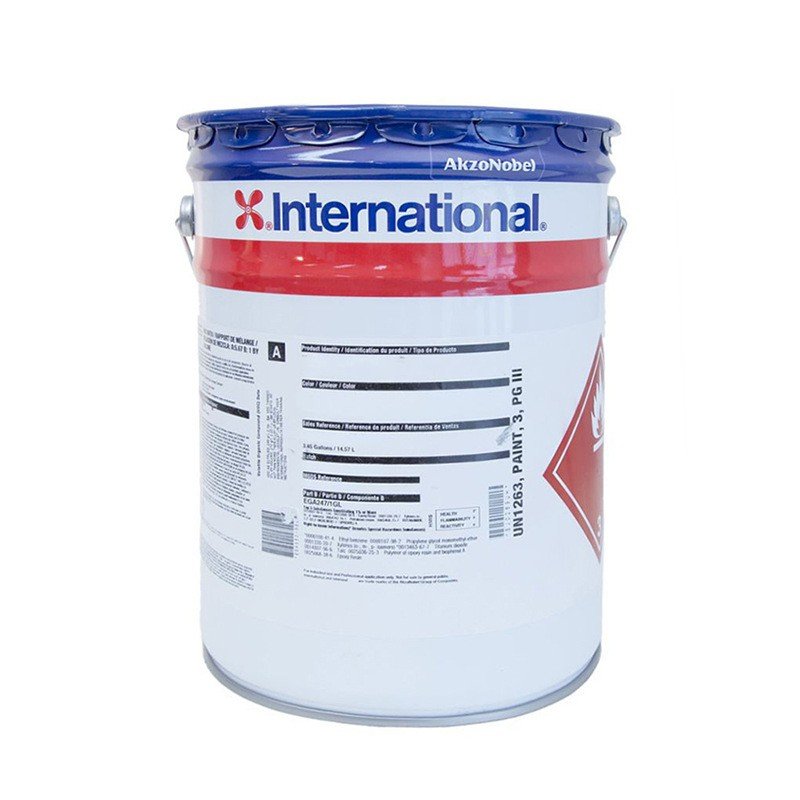
Interchar 212 Epoxy Intumescent Fire Protection Coating is a fire protection paint, an epoxy coating system. Interchar 212 uses durable epoxy technology to provide off-site fabrication and fire protection material for steel structures, away from the construction site. Unlike many other products on the market, Interchar 212 requires no additional surface coating and no reinforcement to provide complete fire protection for steel structures. As with all epoxy coatings, external exposure of Interchar 212 will cause chalking and discolouration. These phenomena do not impair fire protection performance. Where an aesthetically pleasing finish is required, a recommended topcoat should be applied. Parameters on this page: volume solids 100%, number of components: two.
Data source: AKZONOBEL original Technical Data Sheet (TDS), "Interchar 212 Epoxy Intumescent Fire Protection Coating"; spreading rate and other values are converted from the TDS parameters, for selection reference only.
The above content is compiled from the manufacturer's datasheet and this site's parameter tables. For selection, coating systems and lead times, pleaseContact Usfor confirmation.
This page carries the full TDS for this product, translated from the manufacturer's original document. No file download is needed; for an original-language copy, send an enquiry.
| Volume Solids | 100% |
|---|---|
| Dry Film Thickness | — |
| Theoretical Spreading Rate | — |
| VOC | 0.09 lb/gal (11 g/L) US EPA Method 24 2 g… |
| Density / Specific Gravity | 1 kg/L (8.3 lb/gal) (multi-component airless spray) |
| Number of Components | Two-component |
| Thinner | International GTA123 for pre-mixing and trowelling only - see In… |
| Mixing Ratio | 2.49 parts : 1 part by weight. Always mix the whole unit of coating |
| Colour / Appearance | Medium grey, INTERCHAR 212 |
For more Q&A on selection, application, acceptance and defect diagnosis, seeFAQsection.
A high-performance, high-build, solvent-free, two-component modified epoxy intumescent fire protection coating, designed to protect steel structures in cellulosic fires.
Independently fire-tested and complies with the following standards: UL 263/UL 2431 classification Category I-A external exposure requirements, BS 476 Parts 20-22, GOST (Russia), EAD 350402-00-1106, Korean Standard F 2257, Australian Standards AS 1530.4 (2014) and AS 4100.
Interchar 212 is applied off-site with professional spray equipment, achieving the required fire protection in only one to two coats (e.g. 2 hours). The product has excellent anti-corrosion and mechanical properties. Unlike many other products on the market, Interchar 212 requires no additional surface coating and no reinforcement to provide complete fire protection for steel structures.
Interchar 212 is a spray-applied material that requires no additional reinforcement in service.
Helps maintain the integrity of steel structures in cellulosic fires. Typical structures requiring this protection include many public access facilities, such as airport terminals, leisure facilities, conference centres, educational facilities, shopping malls, industrial plants and hotels.
Interchar 212 uses durable epoxy technology to provide off-site fabrication and fire protection material for steel structures, away from the construction site. This not only helps optimise quality management but also shortens the construction period.
| Colour | Medium grey, INTERCHAR 212 |
|---|---|
| Gloss | Matt mottled coating |
| Volume Solids | 100% |
| Typical thickness | 2 mm–8 mm (depending on protection level), with a typical thickness of 3.5 mm (0.14 inch) per coat |
| Theoretical Spreading Rate | 1 kg of Interchar 212 provides a 1 mm fire protection coating for a 1 m² area (based on plural-component spray application) |
| Practical Spreading Rate | Allowing for a suitable loss factor |
| Density | 1 kg/L (8.3 lb/gal) (multi-component airless spray) |
| Application Methods | Two-component (plural-component) heated airless spray or modified single-component spray. Drying time and self-overcoating interval |
| Temperature | Surface Dry | Hard Dry | Minimum | Maximum |
| 10°C (50°F) | 8 h | 24 h | 4 h | * |
| 20°C (68°F) | 5 h | 18 h | 3 h | * |
| 40°C (104°F) | 2 h | 6 h | 2 h | * |
*Consult AkzoNobel for more information. All drying time data is based on a typical thickness of 3.5 mm.
| Flash point (typical) | Component A >106 °C (223 °F); Component B >106 °C (223 °F); mixed >106 °C (223 °F) |
|---|---|
| Volatile Organic Compounds | 0.09 lb/gal (11 g/L) US EPA Method 24; 2 g/kg EU Solvent Emissions Directive content, Commission Directive 1999/13. For more details, see the "Product Characteristics" section. |
All surfaces to be painted must be clean, dry and free of contaminants. Before painting, all surfaces must be assessed and prepared in accordance with ISO 8504:2000.
The steel surface must be abrasive blast cleaned and a modified primer applied. The blasting requirements should be consistent with those for the primer in the technical data sheet. General blasting requirements should achieve Sa 2½ (ISO 8501-1:2007) or SSPC-SP6, producing a minimum roughness of 50 µm (2 mils). The choice of primer depends on the environment in which the fire protection system is used.
Interchar 212 can be applied to galvanized steel structures. The steel surface must be blasted to produce a roughness approaching Sa 1 (ISO 8501-1), SSPC-SP7 or NACE No. 4. Normally blasting produces a roughness of 15–25 µm; the primer should be applied immediately after blasting.
| Mixing | If using a modified airless spray machine or trowel, first mix a complete kit of Interchar 212 thoroughly with a power tool. Each mixed batch should be stored at 21–27 °C (70–80 °F) for 24 hours before use and stirred thoroughly before mixing. |
|---|
Before application with a two-component spray pump, keep each component at 30–34 °C (86–93 °F) for 24 hours (up to 48 hours maximum).
| Mixing ratio | 2.49 parts : 1 part by weight. Always mix the whole unit of coating |
|---|
| Pot life | 15°C (59°F) | 25°C (77°F) |
| 120 min | 90 min |
| Plural-component airless spray | AkzoNobel-approved heated dual pump equipment is recommended. |
|---|---|
| Suitable for airless spray | Suitable |
| Trowel application | Applicable — for small-area repair only |
| Thinner | International GTA123 for pre-mixing and trowelling only - see the Interchar 212 application specification manual. International GTA822; International GTA853. |
| Cleaner | International GTA822 |
| Interruption of work | Do not leave paint in hoses, spray guns or spray equipment. Flush all equipment thoroughly with GTA822 |
| Cleaning | All equipment should be cleaned immediately after use with International thinner. Flushing spray equipment periodically during daily work is good practice. Cleaning frequency depends on the volume sprayed, temperature, spraying time, including interruptions, and other factors. |
Surplus paint and empty containers must be disposed of in accordance with the relevant regional regulations.
Before using Interchar epoxy coatings, the "Recommended Application Procedure" must be carefully reviewed. In addition, International Paint must be contacted as required to ensure that training in the application and use of the coating can be arranged if needed. The product application guide provides additional information on the product and should be used together with the product data sheet. International Paint recommends applying this coating with plural-component equipment; using other application methods will result in higher consumption and waste.
When applying Interchar 212 in confined spaces, ensure adequate ventilation.
The final surface appearance of the product depends on the application method.
Do not apply this product when the steel temperature is below 5 °C (41 °F). This product will not cure below 5 °C (41 °F). For ideal performance, the ambient curing temperature should be kept above 10 °C (50 °F). The surface to be coated must be at least 3 °C (5 °F) above the dew point.
As with all epoxy coatings, external exposure of Interchar 212 will cause chalking and discolouration. These phenomena do not impair fire protection performance. Where an aesthetically pleasing finish is required, a recommended topcoat should be applied.
With multi-coat systems, keep the recoat interval as short as possible to achieve ideal intercoat adhesion.
International Paint can provide on-site service; however, it is the responsibility of the application contractor to notify International Paint of the scheduled application date. If on-site service is provided, quality control remains the responsibility of the applicators, but must at least comply with the procedures specified by the customer and International Paint.
Interchar 212 is certified to the following standards: • BS 476 Pt 20-22:1987 fire rating up to 2 hours • GOST Russia, fire rating up to 2 hours • UL 263 (exterior listing) USA, fire rating up to 3 hours • EAD 350402-00-1106 - continental Europe, assessed up to 2 hours (ETA-1-/0470) • Korean Standard F 2257 - fire rating up to 2 hours • Australian Standards AS 1530.4-2014 and AS 4100.
Note: the VOC value given is based on the maximum possible value for the product and may vary with colour and general production tolerances.
Although the low-molecular-weight reactive additive becomes part of the film when cured under normal ambient conditions, analysis by EPA Method 24 shows that it also affects the VOC value.
The following primers are approved for use with Interchar 212: The following primers are approved for use with Interchar 212
| Intercure 200 | Intercure 200HS |
|---|---|
| Intergard 251 | Intergard 269 |
| Intergard 2575 | Interseal 1052. The following topcoats are approved for use with Interchar 212 |
| Interfine 878 | Interfine 979 |
| Interthane 870 | Interthane 990Interthane 990SG |
For more information on the industry standards, terminology and abbreviations used in this data sheet, see the following documents available at www.international-pc.com: • Definitions and Abbreviations • Surface Preparation • Paint Application • Theoretical and Practical Spreading Rates • Interchar Epoxy Coating Application Procedures. These sections are available as separate publications on request.
This product must be applied at the production site by professional applicators in accordance with the recommendations in this manual, the Material Safety Data Sheet and the instructions on the container label. Do not use this product without first reviewing the Material Safety Data Sheet (MSDS) that International Paint provides for its customers.
All work related to the application and use of this product must be carried out in accordance with the relevant national health, safety and environmental standards and regulations.
If welding or flame cutting is required on metal coated with this product, dust and fumes will be generated; use appropriate personal protective equipment and adequate local ventilation.
If in doubt about the suitability of this product for the intended use, consult AkzoNobel for further advice.
| Packaging Specifications | Component A | Component B | ||
| Weight | Packaging | Weight | Packaging | |
| 20 kg | 14.2 kg | 20 L | 5.8 kg | 6 L |
| 50 kg | 35.6 kg | 20 L | 14.4 kg | 20 L |
For other packaging sizes, contact AkzoNobel.
| Packaging Specifications | Component A | Component B |
| 20 kg | 15.98 kg | 6.35 kg |
| 50 kg | 39.16 kg | 16.18 kg |
U.N. shipping number: non-hazardous
| Shelf life | Minimum 18 months at 25 °C (77 °F). |
|---|
Thereafter, inspection is required. Store in a dry, cool environment away from heat and sources of ignition.
© 2022/9/1 AkzoNobel. All rights reserved.
www.international-pc.com
Information is subject to the manufacturer's latest version; the manufacturer's latest TDS prevails.
The technical parameters on this page are taken from the product's original manufacturer technical datasheet, the copyright of which belongs to the manufacturer. If a rights holder considers the presentation inappropriate, contact us for verification and handling.
Packaging specifications and batch lead times are subject to actual availability. PleaseContact Uscontact us for project-based calculation.