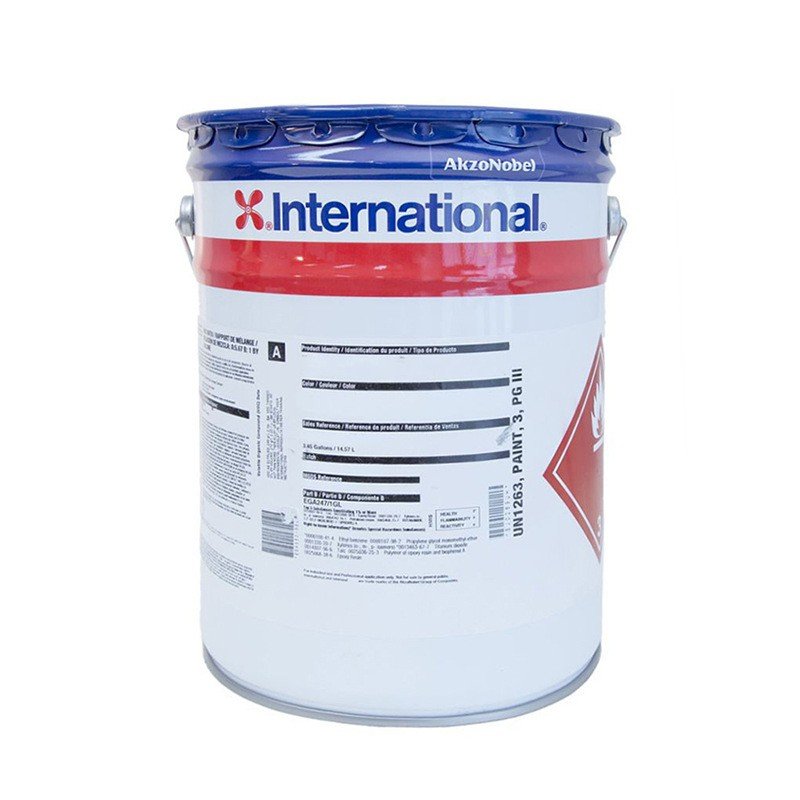
Enviroline 125LV Ultra-high-solids Two-component Epoxy Lining System is an epoxy coating. Enviroline 125LV is an ultra-high-solids two-component epoxy lining system. Although the low-molecular-weight reactive additive becomes part of the film when cured under normal ambient conditions, EPA Method 24 analysis shows that it also affects the VOC value. Parameters on this page: volume solids 96% ± 2%; theoretical spreading rate 1.30 m²/L; number of components: two. Comparable products from the same brand: Ceilcote 68 Lining, Enviroline 125U New-generation Lining System, Enviroline 222 Two-component Polycycloamine-cured Lining System.
Source: AKZONOBEL original technical data sheet (TDS) 'Enviroline 125LV Ultra-high-solids Two-component Epoxy Lining System'. Spreading rate and other values converted from the TDS; for reference only.
The above content is compiled from the manufacturer's datasheet and this site's parameter tables. For selection, coating systems and lead times, pleaseContact Usfor confirmation.
This page carries the full TDS for this product, translated from the manufacturer's original document. No file download is needed; for an original-language copy, send an enquiry.
| Volume Solids | 96% ± 2% |
|---|---|
| Dry Film Thickness | — |
| Theoretical Spreading Rate | 1.30 m²/L |
| VOC | 0.40 lb/gal (48 g/L), US EPA Method 24, 66 … |
| Density / Specific Gravity | 1.46 kg/L (12.2 lb/gal) |
| Number of Components | Two-component |
| Thinner | For specific advice, refer to the Enviroline Application Guide |
| Mixing Ratio | 2 parts : 1 part (by volume) |
| Colour / Appearance | Available in a limited range of colours, ENVIROLINE 125LV |
For more Q&A on selection, application, acceptance and defect diagnosis, seeFAQsection.
Enviroline 125LV is an ultra-high-solids two-component epoxy lining system.
Enviroline 125LV is a technically advanced epoxy lining system with improved performance: - resistance to gasoline, alcohol and gasoline-blended fuels - high impact and abrasion resistance - tolerance of high-temperature immersion (e.g. up to 60 °C (140 °F)) - ultra-low VOC - single-coat application - fast curing (return to service within 24 hours at 25 °C (77 °F)) - meets the performance requirements of AWWA C-210-07. Used as steel and concrete linings in oil and gas, chemical, pulp and paper, mining and water treatment industries. Enviroline 125LV is normally used for crude oil storage tanks, floors, secondary containment and the interior/exterior of buried pipelines.
| Colour | Available in a limited range of colours, ENVIROLINE 125LV |
|---|---|
| Gloss | N/A |
| Volume Solids | 96% ± 2% |
| Typical thickness | For walls: 300–400 µm (12–16 mils) dry film, equivalent to 313–417 µm (12.5–16.7 mils) wet film; for floors: 500–1000 µm (20–40 mils) dry film, equivalent to 521–1042 µm (20.8–41.7 mils) wet film |
| Theoretical Spreading Rate | At 750 µm dry film thickness and the stated volume solids: 1.30 m²/L; at 30 mils dry film thickness and the stated volume solids: 51 ft²/US gal |
| Practical Spreading Rate | Allowing for a suitable loss factor |
| Application Methods | Suitable for airless spray, plural-component airless spray. Drying time; self-recoat interval |
| Temperature | Surface Dry | Hard Dry | Minimum | Maximum |
| 25°C (77°F) | 4 h | 5 h¹ | 3 h | 6 h² |
¹ Allow the film to reach sufficient strength before handling the coated steelwork. A Shore D hardness of 75–80 is recommended as a suitable value for return to service.
² If the maximum recoat interval is exceeded, abrade the lining surface thoroughly with coarse abrasive paper.
| Flash point (typical) | Mixed 66 °C (151 °F) |
|---|---|
| Product weight | 1.46 kg/L (12.2 lb/gal) |
| Volatile Organic Compounds | 0.40 lb/gal (48 g/L), US EPA Method 24; 66 g/kg, EU Solvent Emissions Directive (Commission Directive 1999/13). For more details, refer to the 'Product Characteristics' section. |
All surfaces to be coated must be clean, dry and free of contamination. Before painting, all surfaces must be assessed and prepared in accordance with ISO 8504:2000.
Where necessary, remove weld spatter and grind welds and sharp edges smooth.
Oil and grease must be removed in accordance with the SSPC-SP1 solvent cleaning standard.
Blasting: for optimum performance, Enviroline 125LV must be applied over surfaces blasted to Sa 3 (ISO 8501-1:2007) or SSPC-SP5. If not used in high-temperature and/or aggressive environments, Enviroline 125LV can be used over surfaces blasted to Sa 2½ (ISO 8501-1:2007) or SSPC-SP10. Consult International Protective Coatings for details.
Recommended surface roughness 75–125 µm (3–5 mils).
Enviroline 125LV must be applied before the steel oxidizes. If oxidation has occurred, re-blast the oxidized areas to the specified standard.
Surface defects exposed by blasting must be ground, filled or treated by a suitable method.
Blast cleanliness can be maintained by dehumidification, or an approved temporary primer can be applied.
For concrete surfaces, consult the International Paint Protective Coatings division for professional advice.
| Mixing | This product is supplied in two containers as one unit. The entire unit should be stored, mixed and applied in accordance with the Enviroline Application Guide. |
|---|---|
| Mixing ratio | 2 parts : 1 part (by volume) |
| Pot life | 25°C (77°F) | 40°C (104°F) |
| 41 min | 18 min |
| Plural-component airless spray | Recommended | For further information, refer to the Enviroline Application Guide. |
| Suitable for airless spray | Applicable | For further information, refer to the Enviroline Application Guide. |
| Air Spray | N/A |
(with pressure pot)
| Brush | Applicable | For small-area repair or touch-up of welds and edges. |
| Thinner | Generally not required | For specific advice, refer to the Enviroline Application Guide. |
| Cleaner | Enviroline 71C |
| Interruption of work | Do not leave paint in hoses, spray guns or spray equipment. Flush all equipment thoroughly with Enviroline 71C. Once mixed, paint should not be resealed. If work is interrupted for a long time, use a freshly mixed batch when resuming. |
|---|---|
| Cleaning | Clean all equipment immediately after use with Enviroline 71C. Flushing spray equipment periodically during daily work is good practice. Cleaning frequency depends on the volume sprayed, temperature and time, including all delays. |
Surplus paint and empty containers must be disposed of in accordance with the relevant laws/regional regulations.
Read the Enviroline Application Guide carefully before use.
This datasheet provides a brief guide to using Enviroline 125LV. Specific project requirements depend on the end use of the tank or vessel and the working conditions. Always consult International Protective Coatings to confirm the suitability of Enviroline 125LV for the product to be stored.
Always follow the detailed coating specification recommended by the International Paint Protective Coatings division.
Touch-up is a fundamental requirement of good working practice; it should be part of any lining system.
For heavily pitted or porous steel, apply about 50% of the required film thickness by spray, then immediately roll with a short-nap roller or squeegee to work the coating into the bottom of pits.
For airless spray, heat the components to 35–37 °C (95–100 °F) before mixing for optimum performance.
The temperature of the surface to be coated must be at least 3 °C (5 °F) above the dew point.
For the ideal temperature conditions, see the table below. Throughout curing, in addition to meeting these conditions, adequate ventilation must be maintained.
Substrate; environment
| Ideal 21–49 °C (70–120 °F) | 21-38 °C(70-100°F) |
|---|---|
| Minimum 13 °C (55 °F) | 13 °C (55 °F). After the coating system is fully cured, check the minimum thickness of the system using a non-destructive magnetic gauge. The entire system must be free of pinholes and bare spots. The cured film must be free of sags, runs, drips, inclusions or other defects. All defects and deficiencies must be repaired. Repaired areas must be retested and fully cured before the lining is put into service. |
Although baking is not required in most applications, it may be used to accelerate curing or to enhance chemical resistance under extremely corrosive conditions. For maximum chemical resistance, bake at 121 °C (250 °F) for at least 2 hours, or at 66 °C for 6–8 hours.
Enviroline 125LV withstands a maximum continuous dry temperature of 149 °C (300 °F).
This product meets the performance requirements of AWWA C210-07. Note: the VOC value is a typical value for guidance only. It may vary with colour and normal production tolerance.
Although the low-molecular-weight reactive additive becomes part of the film when cured under normal ambient conditions, analysis by EPA Method 24 shows that it also affects the VOC value.
Enviroline 125LV should always be applied over a correctly prepared substrate. When a primer is required as part of the system, consult International Protective Coatings for professional advice.
Enviroline 125LV is a single-coat system. Where necessary, it must only be recoated or repaired with itself.
| For further information on the industry standards, terms and abbreviations used in this datasheet, see www.international-pc.com | In the following documents on the website: • Definitions and abbreviations • Surface preparation • Coating application • Theoretical and practical spreading rate • Enviroline Application Guide. These sections are available on request. |
|---|
This product is intended for professional applicators in industrial use only.
All work, including the application and use of this product, must comply with the relevant national standards, laws and regulations on safety, health and environmental protection.
During application and the subsequent drying period (for common drying times, see the product data sheet), provide adequate ventilation to keep solvent concentrations within safe limits and prevent fire and explosion. Forced ventilation is required in confined spaces. During application and drying, personal ventilation and respiratory protection (e.g. air-fed hood or suitable filter mask) must also be provided. Take the necessary measures to prevent skin and eye contact with the coating (e.g. protective clothing, gloves, goggles, mask, barrier cream).
Before use, read and follow the Material Safety Data Sheet and the Health and Safety section of the application procedure for this product (for two-component coatings, those of the base and curing agent).
If welding or cutting is performed on metal substrate previously coated with this product, dust and fumes will be released; use suitable personal protective equipment and local exhaust ventilation.
The specific safety measures depend on the application method and working environment. If these warnings or instructions are not fully understood or cannot be strictly observed, do not use the product and consult International Paint.
Warning: this product contains liquid epoxy and modified polyamines and may cause skin sensitisation if handled improperly.
| Packaging Specifications | Component A | Component B | ||
| Volume | Packaging | Volume | Packaging | |
| 4 US gal | 2.67 US gal | 5 US gal | 1.33 US gal | 2 US gal |
| 18 L | 12 L | 20 L | 6 L | 10 L |
For other available packaging sizes, contact International Paint.
| Packaging Specifications | Component A | Component B |
| 4 US gal | 33 lb | 16.7 lb |
| 18 L | 16.51 kg | 9.91 kg |
| Shelf life | At 25 °C (77 °F), sealed paint can be stored for 24 months. Thereafter, inspection is required. Store in a dry, cool environment away from heat and sources of ignition. |
|---|
The information given in this product data sheet is not exhaustive. Anyone who uses, for any purpose, any product other than those specifically recommended in this data sheet without first obtaining our written confirmation does so at their own risk as regards the suitability of the product for the intended purpose. Although to the best of our knowledge all advice or statements given about the product (whether in this data sheet or otherwise) are correct, we cannot control the quality or condition of the substrate, nor the many factors affecting the use and application of the product. Accordingly, unless we specifically agree otherwise in writing, we accept no liability, to the maximum extent permitted by law, for any product performance problem arising, or for any loss or damage caused by use of the product. We hereby disclaim any warranty or representation, express or implied, arising by operation of law or otherwise, including but not limited to any implied warranty of merchantability or fitness for a particular purpose. All products supplied and all technical guidance provided are subject to our standard terms and conditions of sale. You should obtain a copy of this document and read it carefully. The information contained in this product data sheet may be amended at any time in the light of experience and of our product development policy. Before using the product, it is the customer's responsibility to check with the local representative that the data sheet in their possession is the latest version.
This product data sheet is available on www.international-marine.com or www.international-pc.com and should be identical to this copy. If the version on the website differs from this one, the version on the website shall prevail.
© 2015/2/5 AkzoNobel. All rights reserved.
www.envirolinegroup.comwww.international-pc.com
Data is subject to the manufacturer's latest version; in all cases the manufacturer's latest TDS prevails.
Packaging specifications and batch lead times are subject to actual availability. PleaseContact Uscontact us for project-based calculation.